


Federal law bars fees for help with an initial VA benefits claim.
A veteran filing a first disability claim can pay nothing for expert help, and federal law is written to keep it that way. Yet plenty of veterans still hand over money, personal data, or a share of their future back pay to people who were never allowed to ask for it.
The rules are not complicated. Knowing three of them, and one free lookup tool, covers most of the risk.
Fraud Aimed at Veterans Is Common
The pressure is real. In a 2025 AARP survey of 1,596 adults, including an added sample of 570 veterans and active-duty service members, 39 percent of veterans said they had received solicitations from someone claiming to be from the Department of Veterans Affairs or another government agency.
The same survey found that 28 percent believed their veteran status made them a target, and 27 percent had lost money to fraud, most of them more than $500. NORC at the University of Chicago fielded the survey by phone and online in March 2025.
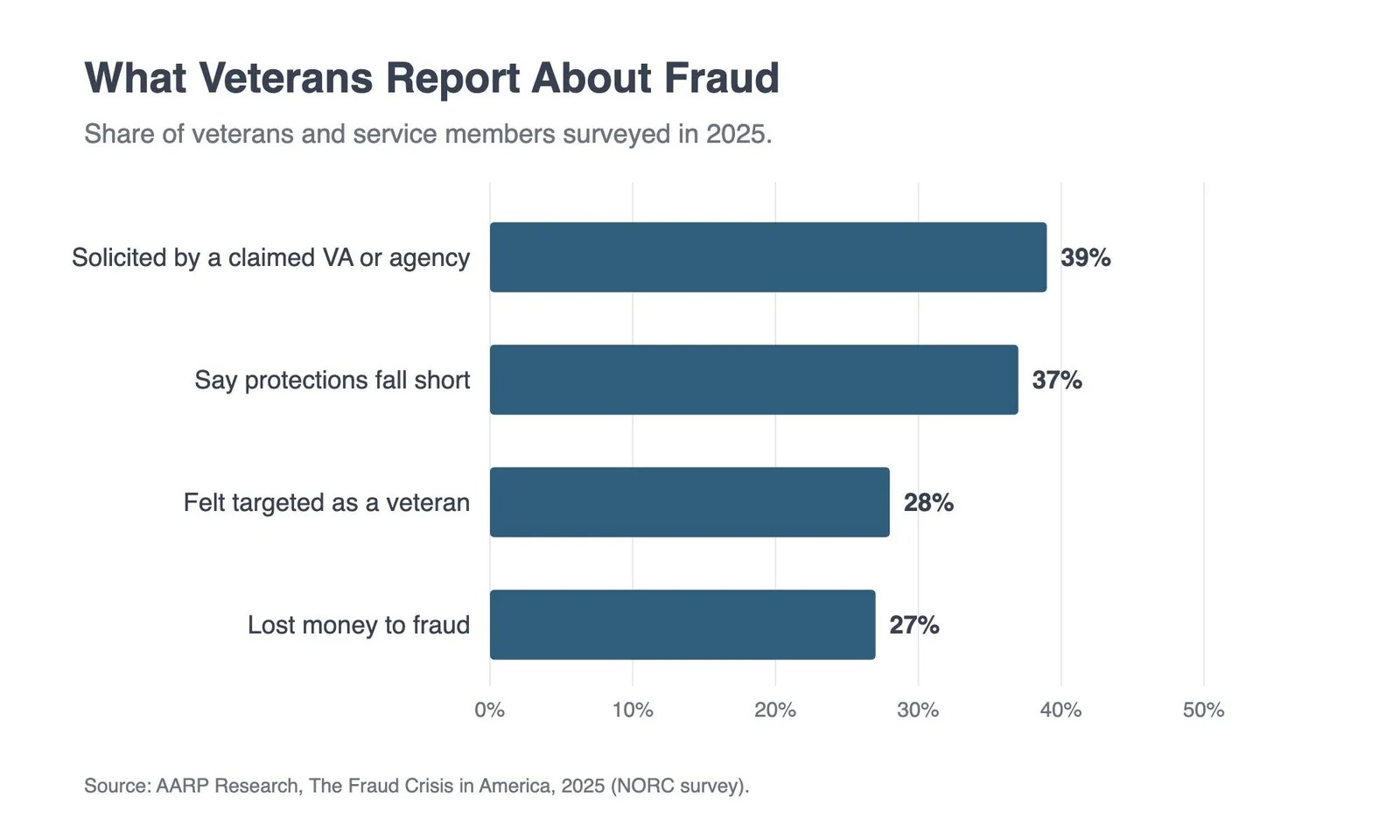
Results from AARP’s 2025 survey of veterans and service members.
More than a third, 37 percent, said there are not enough resources to help protect veterans. That gap is where unaccredited “consultants” tend to show up, often with a pitch about getting a higher rating faster. The pitch usually sounds helpful, which is exactly why the fee rules matter more than the sales language.
Rule One: No Fee on an Initial Claim
Federal law sets the line clearly. Under 38 U.S.C. 5904, a fee “may not be charged, allowed, or paid” for the services of agents and attorneys provided before a claimant receives notice of VA’s initial decision on the claim.
In practice, that means the first filing is not a paid service. Anyone who asks for money up front, a monthly retainer, or a percentage of future benefits to prepare an initial claim is asking for something the law does not allow.
Rule Two: VSO Representatives Never Charge
Veterans service organizations are the most common source of help, and they work for free. VA’s own guidance on accredited representatives states that the services an accredited VSO representative provides on a VA benefit claim “are always free.”
The same guidance notes that veterans turn to VSO representatives more than other types of representatives on initial claims. It also says some accredited attorneys and claims agents help on initial claims for free.
Rule Three: Paid Help Comes Later, With Paperwork
Accredited attorneys and claims agents can charge, but only at a later stage. According to the same VA guidance, they may charge fees only after VA has made a decision on the initial claim and has received a fee agreement signed by both the veteran and the representative.
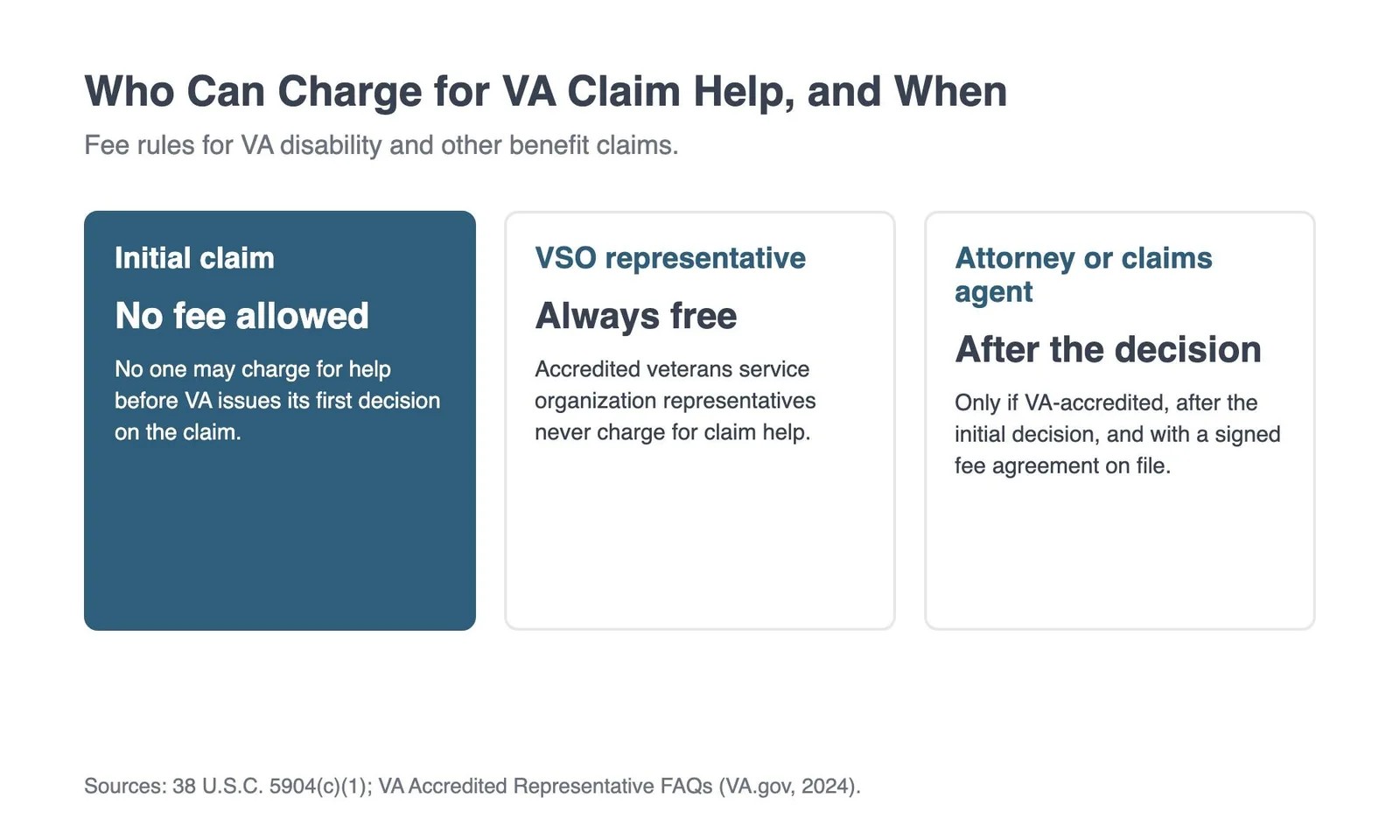
Who may charge for help with a VA claim, and at what stage.
That later stage usually means a Supplemental Claim, a Higher-Level Review, or an appeal to the Board of Veterans’ Appeals. A paid representative is a legitimate choice there. The point is that the fee terms should be in writing, on file with VA, and agreed to before the work starts.
What Accreditation Actually Means
Accreditation is not a marketing label. VA’s guidance spells out who qualifies: an accredited attorney must be a member in good standing of at least one state bar, and an accredited claims agent must pass a written test about VA laws and procedures.
The guidance also gives veterans a firm right to change course. A veteran can discharge an accredited representative at any time and for any reason, or appoint a new one to replace the current one.
Before hiring a paid attorney or agent, VA suggests talking through the fee amount, how it will be paid, and what happens if the veteran later ends the arrangement. Those three answers belong in the written agreement, not in a phone conversation.
How to Check Anyone Who Offers Help
The fastest protection is a lookup. VA’s accreditation search, run by the Office of General Counsel, lists attorneys, claims agents, and VSO representatives who are currently accredited. It can be searched by name, city, state, or ZIP code.
The tool is plain about what a missing name means. If a search returns no result, the person “is not currently authorized to provide representation,” though an application may be pending. The data refreshes every Monday, Wednesday, and Friday evening.
A few habits make the check worth more:
- Search the exact name of the person, not only the company they work for.
- Ask any paid representative to explain the fee in writing before signing anything.
- Do not share a VA.gov login with anyone, even someone who offers to “handle everything.”
- Report suspected fraud to VA’s VSAFE Fraud Hotline at 833-38V-SAFE (8-7233).
Where Peer Groups Fit
Accredited representatives file claims. Peer groups do something different. Veterans View Network, a small peer community for veterans in the years after service, offers free help finding an accredited representative and verifying anyone who claims to represent a veteran.
The group states that it does not prepare or submit claims, does not ask for VA.gov login credentials, and does not refer veterans to paid claims preparers. That kind of plain disclosure is a useful test for any organization offering help: it should say what it will not do as clearly as what it will.
The Market Around Claims Help
Every year, VA claims bring in a steady stream of new filers, and the help market grows around them. Some of it is excellent and free. Some of it charges for work federal law says should cost nothing.
The tools to tell the difference already exist and cost nothing to use. A veteran who checks the accreditation search, asks when a fee would start, and keeps a VA.gov login private has already avoided most of what goes wrong. The harder problem is reach: surveys like AARP’s suggest many veterans still meet the pitch before they meet the rules.