
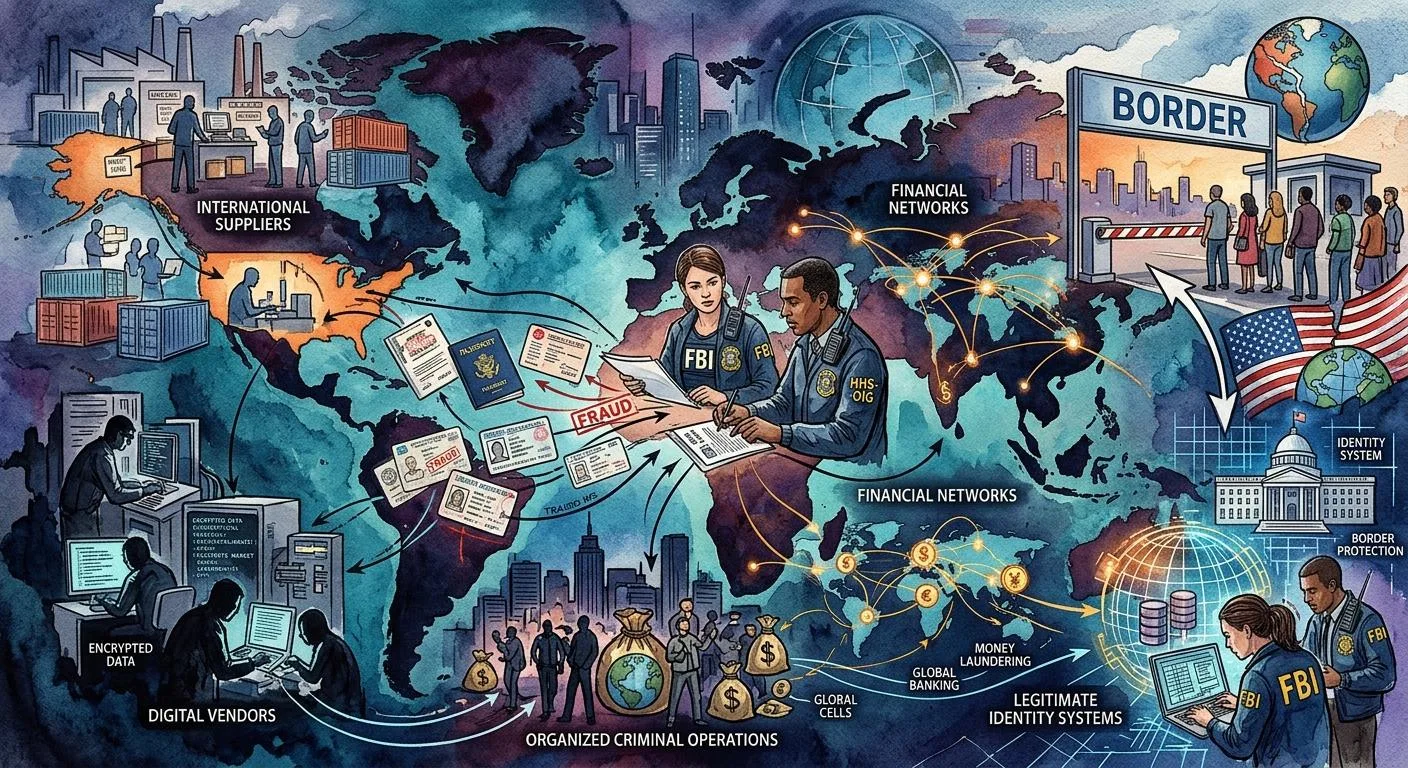
Federal investigators are expanding document fraud investigations beyond individual counterfeit passports to target international suppliers, digital vendors, financial networks, and organized criminal operations that threaten border security and legitimate identity systems.
WASHINGTON, DC, November 12, 2026 — As counterfeit passports and fraudulent identification documents grow more sophisticated, law enforcement agencies are expanding investigations beyond suspicious credentials to identify the criminal organizations, financial intermediaries, and international distribution networks that produce and circulate them.
The emerging enforcement strategy recognizes that intercepting a forged passport at an airport, financial institution, or traffic stop is only one opportunity to investigate a broader operation involving document suppliers, identity thieves, couriers, and criminal financiers.
Federal, state, and local investigators are increasingly examining connections between passport fraud, human smuggling, financial deception, and identity theft, reflecting the recognition that fraudulent documents often serve as tools supporting broader criminal enterprises.
Recent prosecutions and international enforcement operations have shown the importance of coordinated investigations, electronic evidence, financial intelligence, and information sharing in identifying suspected organizers rather than focusing exclusively on individuals found carrying counterfeit identification.
Passport Fraud Investigations Expand Beyond Individual Suspects
Traditionally, an encounter with a suspicious passport could begin with an inspection of physical security features, personal information and document validity, followed by further investigation when officials identified inconsistencies suggesting forgery or unauthorized use.
Modern investigations increasingly examine what suspicious documents reveal about their origins, distribution and possible connections to other offenses, particularly when multiple cases involve similar fraudulent identities, common suppliers or related financial transactions.
A counterfeit passport may be the final product of an organized criminal operation involving identity-data acquisition, document production, customer recruitment, distribution, and payment processing across multiple national jurisdictions and communication platforms.
Investigators seeking to understand these relationships must distinguish between isolated document misuse and coordinated criminal activity, using independently corroborated evidence rather than assuming that every fraudulent passport necessarily originated from an international organization.
The broader investigative objective is to identify individuals who direct or profit from organized document fraud and determine whether seemingly separate incidents can be linked through legitimate evidentiary analysis and cooperation among authorities.
Federal Prosecutors Identify Organized Identity Fraud Operations
American prosecutions in 2026 have shown how fraudulent passport investigations can uncover allegations involving financial crimes, identity theft, and coordinated activities that extend beyond the immediate possession of suspicious travel documents.
In March, federal prosecutors in Florida announced charges against three Pensacola residents accused of participating in a conspiracy involving bank fraud, false passport use and aggravated identity theft, following an investigation involving several government agencies.
According to the U.S. Department of Justice’s March 24, 2026, announcement, the investigation included the Diplomatic Security Service, Homeland Security Investigations, the Escambia County Sheriff’s Office, and the Treasury Inspector General for Tax Administration.
The involvement of multiple agencies shows why suspected identity-document offenses can require expertise beyond immigration enforcement, especially when investigators examine potential banking violations, stolen personal information, and fraudulent representations.
The charges remain allegations unless established in court, and the defendants retain the presumption of innocence, but the case demonstrates how document-related investigations can require coordinated action across federal and local jurisdictions.
Routine Police Encounters Can Reveal Larger Criminal Activity
Local police officers can become important participants in document fraud investigations when routine encounters reveal suspicious identification, financial records or other evidence suggesting offenses that extend beyond the original circumstances of an inspection.
A federal case in eastern Texas showed this connection when prosecutors described a traffic stop that uncovered counterfeit United States passport cards and related banking documents, which later led investigators to a broader identity fraud operation.
Authorities reported that the ensuing investigation identified personal information belonging to more than 80 individuals and passport-style photographs linked to 12 people, underscoring the importance of examining suspected counterfeit identification beyond its immediate possession.
Two defendants were sentenced in April 2026 following the investigation, which involved the State Department’s Diplomatic Security Service, the Flower Mound Police Department and the United States Secret Service.
The case demonstrates how an apparently limited police encounter can develop into an investigation involving federal document crimes, financial activity and numerous potential identity victims when participating agencies share evidence and investigative findings.
International Operations Reveal the Structure of Forgery Networks
European authorities have documented similar links between document fraud, organized migration offenses, and criminal financial activity, providing examples of investigations that move beyond individual travelers to suspected suppliers and network coordinators.
On September 22, 2026, law enforcement authorities conducted coordinated operations in Austria, Italy, Spain and Britain following an international investigation into a suspected migrant-smuggling network involved in document fraud and money laundering.
Europol reported that the operation involved cooperation among authorities from 17 countries and resulted in six arrests, 10 property searches, and seizures of identification documents, electronic equipment, evidence, and substantial amounts of cash.
Investigators identified suspected criminal cells operating in several countries, including an Austrian-based group associated with fraudulent-document supply and a Spanish-based operation believed to have distributed counterfeit identification across international destinations.
The agency reported investigative indications that more than 1,000 fake identification documents had been distributed through courier networks and that the wider criminal enterprise generated more than 2 million euros in illegal proceeds.
These findings illustrate why document fraud investigations increasingly require analysis of supply chains, financial arrangements and international communication patterns, rather than treating every intercepted counterfeit passport as an unrelated offense.
Financial Investigations Target Profits Behind Counterfeit Documents
The financial infrastructure supporting criminal document operations has become an important investigative concern because suppliers and intermediaries may generate revenue through repeated transactions involving fraudulent identification, transportation arrangements and related illegal services.
Investigators examining financial activity can seek to establish relationships among suspected participants, determine whether proceeds are linked to criminal offenses and identify assets that may become subject to lawful seizure or forfeiture proceedings.
The approach can be particularly relevant when suspected document suppliers operate across international borders, where individual fraudulent credentials may be difficult to trace but documented commercial relationships can help establish connections among alleged conspirators.
British authorities demonstrated this wider enforcement approach in July 2025 when they announced sanctions targeting people-smuggling networks, suspected passport suppliers and financial intermediaries accused of supporting illegal migration operations.
As Reuters reported on Britain’s July 23 sanctions campaign, the measures targeted 24 individuals and one company, including eight people from the Balkans accused of supplying fraudulent passports.
The sanctions also addressed financial arrangements and transportation-related businesses, illustrating how governments can pursue suspected facilitators whose services sustain criminal operations even when those individuals are not personally transporting migrants across borders.
Digital Vendors Complicate Fraud Investigations Across Borders
Online communication has expanded the geographic reach of document-related criminal activity, allowing suspected suppliers to advertise services, communicate with customers and establish commercial relationships without maintaining conventional storefronts or conducting every transaction in person.
Websites, social media accounts and messaging applications can become relevant investigative evidence when authorities suspect organized document fraud, although the existence of online advertising alone does not establish that an individual has committed a crime.
Investigators must distinguish legitimate document assistance from fraudulent services and unrelated internet scams, and determine whether electronic communications establish connections among suspected suppliers, buyers, intermediaries, and financial participants.
Digital evidence may help investigators establish timelines, identify related transactions, and connect activities across jurisdictions, but obtaining and analyzing it requires appropriate legal authority and careful evidentiary procedures.
The international nature of electronic communication also creates jurisdictional complications, because suspected participants, service providers and relevant records may be located in different countries with separate privacy protections and criminal investigation requirements.
Effective cooperation therefore depends on established legal mechanisms for sharing evidence, preserving relevant records and coordinating investigative activity without compromising the rights of individuals who may have been incorrectly associated with suspicious communications.
Passport Authentication Helps Identify Broader Fraud Patterns
Advanced passport security technology can give investigators additional information when evaluating suspected counterfeits, particularly when physical document inconsistencies or failed electronic authentication checks raise questions about a credential’s claimed origin.
Modern passports combine specialized printing, protected identity pages, machine-readable information, and electronic authentication mechanisms to make unauthorized reproduction or alteration harder for criminals seeking convincing identity credentials.
As Amicus International Consulting explains in its examination of modern passport security and counterfeit detection, effective verification requires examining physical security features, electronic passport information, and identity-related evidence together rather than relying solely on visual appearance.
Electronic authentication can help determine whether certain protected information corresponds to data signed by an authorized passport issuer, while biometric comparison may support assessments of whether a document belongs to its presenter.
Neither technique alone establishes every aspect of an individual’s identity or criminal history, so officials must investigate further when they identify discrepancies that ordinary document examination cannot resolve.
When properly documented and lawfully shared, findings from separate authentication examinations may help investigators identify similarities among suspected counterfeit documents and determine whether additional inquiries into possible common origins are justified.
Biometrics Strengthen Identity Verification but Require Oversight
Biometric screening has become another key component of border and identity security, allowing authorized systems to compare travelers’ physical characteristics with reference information linked to legitimate government-issued identity records.
Facial recognition technology may help identify potential impostors presenting authentic documents belonging to other individuals, addressing a problem that cannot necessarily be detected through examination of passport construction or electronic signatures alone.
However, biometric systems can produce uncertain results when image quality, appearance changes or operational conditions affect comparisons, meaning trained personnel must evaluate discrepancies before consequential decisions are made about individual travelers.
Agencies implementing biometric screening must also consider applicable privacy laws, data retention policies, accuracy assessments and procedures for correcting errors, particularly where identity verification findings could affect travel or immigration decisions.
These safeguards are important because a legitimate document holder should not be classified as a criminal participant solely because an automated comparison requires further review or an electronic passport reading encounters technical difficulties.
Federal and Local Agencies Bring Different Investigative Capabilities
Cooperation among federal, state and local law enforcement agencies can improve document fraud investigations by combining local knowledge, specialized federal expertise and access to investigative resources that individual organizations may not possess independently.
Local investigators may first encounter suspicious identification through ordinary criminal inquiries, while federal authorities can assess potential violations involving passports, interstate financial activity, immigration matters or criminal conduct crossing national boundaries.
The State Department’s Diplomatic Security Service handles passport and visa fraud investigations, while Homeland Security Investigations addresses criminal activity that may include identity fraud, financial offenses, and transnational organized crime.
Other agencies, including the FBI and Secret Service, may contribute expertise when suspected document fraud intersects with financial crimes, cyber-enabled offenses, organized criminal activity or offenses falling within their statutory investigative responsibilities.
The effectiveness of these arrangements depends on appropriate information sharing, clear responsibilities and evidence management, ensuring that complex investigations can proceed without unnecessary duplication or unsupported assumptions about suspected criminal associations.
Protecting Victims Remains an Important Enforcement Priority
Organized document fraud can have serious consequences for individuals whose personal information is stolen, particularly when criminals use counterfeit identity documents to establish financial relationships or conduct transactions in another person’s name.
Victims may encounter unauthorized accounts, inaccurate financial records and difficulties establishing their identities, making prompt communication among investigators, financial institutions and relevant government agencies important when fraudulent activity is discovered.
Investigations that identify document suppliers and other suspected organizers can therefore serve a broader protective purpose, helping authorities determine whether stolen information has been distributed or reused across unrelated criminal transactions.
At the same time, authorities must distinguish criminal participants from individuals who have experienced identity theft, coercion or exploitation, especially when evaluating offenses involving migrant smuggling and fraudulent documentation.
International Intelligence Sharing Supports Network Disruption
The international distribution of counterfeit documents creates investigative challenges because suppliers, suspected customers and financial intermediaries may operate in separate jurisdictions, while the evidence connecting them is scattered among different authorities.
Europol’s September 2026 operation illustrates the potential value of cross-border cooperation, with participating agencies examining information from numerous countries to identify suspected criminal cells and relationships among document fraud activities.
International cooperation can also help investigators recognize apparently unrelated counterfeit documents as possible products of connected operations, provided that relevant findings are supported by reliable forensic evidence and appropriate investigative corroboration.
Such efforts require established legal procedures, secure information handling and attention to privacy protections, particularly when authorities exchange personal details concerning individuals who have not been convicted of criminal offenses.
Disrupting Criminal Networks Becomes the Central Enforcement Objective
The growing emphasis on organized document fraud reflects a practical limitation of enforcement strategies focused exclusively on individual counterfeit passports, because removing one fraudulent credential does not necessarily prevent its supplier from distributing others.
Investigators increasingly recognize that sustainable enforcement requires identifying suspected organizers, documenting financial relationships, establishing criminal responsibility and pursuing the distribution systems that allow fraudulent identification to circulate across borders.
For U.S. authorities, cooperation among local police, federal investigators, financial institutions and international partners offers opportunities to address multiple aspects of these operations while strengthening protections for legitimate identity holders.
The challenge will likely remain substantial as criminals exploit evolving communications technology and identity systems, requiring authorities to combine reliable document authentication with coordinated investigations and appropriate legal safeguards.
Ultimately, the shift from counterfeit passport detection to criminal network investigations reflects a broader understanding that protecting border security requires disrupting the organizations behind fraudulent identities, not merely confiscating their documents.