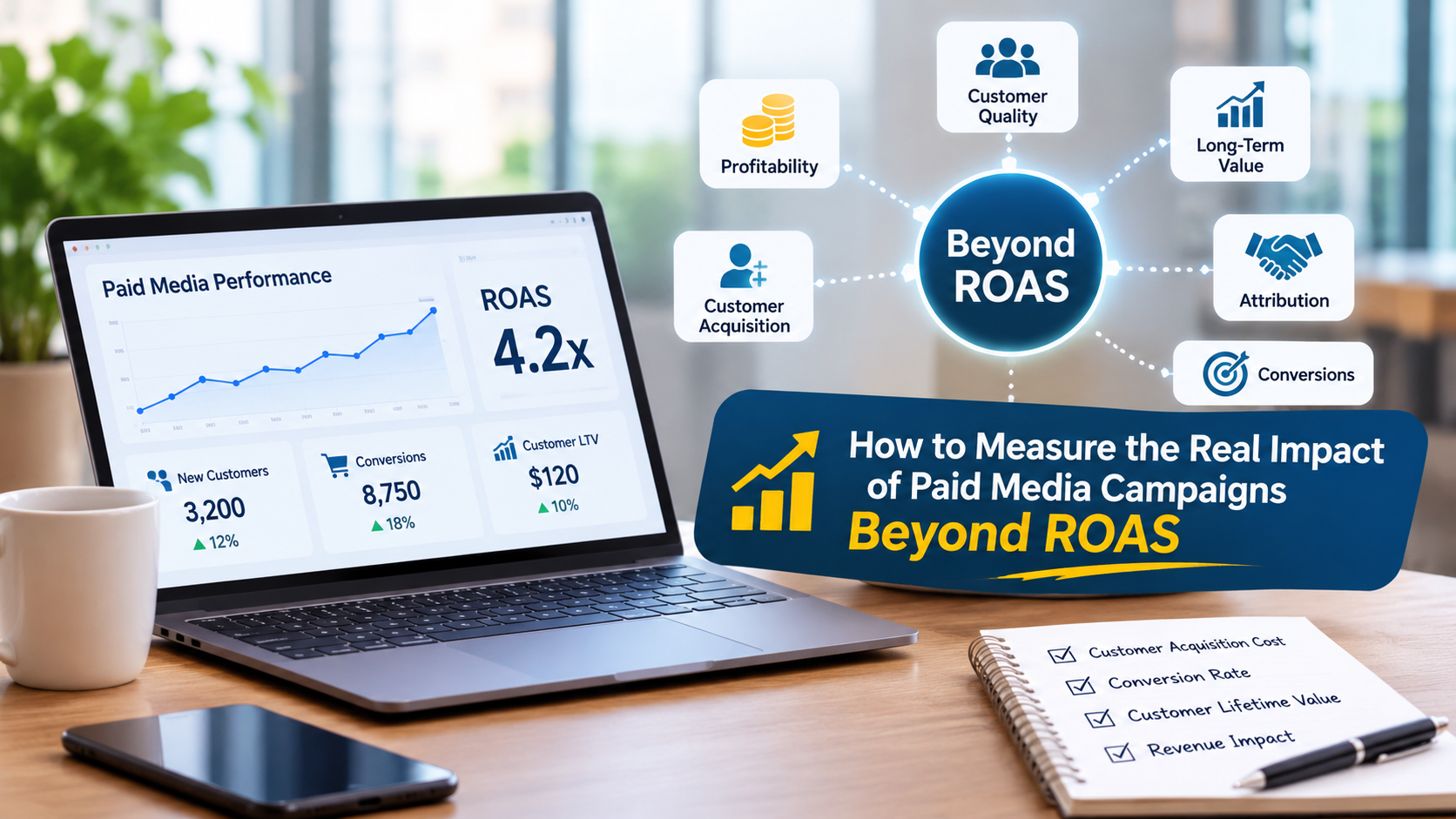
Paid media campaigns are often judged by one important metric: Return on Ad Spend (ROAS). It helps businesses understand how much revenue their advertising generates compared to the amount spent. While this is useful, it does not always show the complete picture of campaign performance.
A campaign may generate impressive revenue but attract low-quality customers, increase acquisition costs, or produce sales that would have happened without advertising. On the other hand, a campaign with a lower ROAS may introduce new customers, improve brand visibility, and create opportunities for future revenue. For businesses investing in Google Ads, social media advertising, display campaigns, and other paid media channels, understanding these differences is essential.
At AimLogic, we believe paid media measurement should go beyond clicks, conversions, and revenue. Businesses need to understand how advertising contributes to customer acquisition, lead quality, and long-term growth.
Let’s look at the metrics and strategies that provide a more complete view of paid media performance.
Why ROAS Alone Doesn’t Tell the Whole Story
ROAS measures the revenue generated for every dollar spent on advertising. The basic formula is:
ROAS = Revenue Generated from Ads ÷ Advertising Spend
For example, if a business spends $5,000 on advertising and generates $20,000 in attributed revenue, its ROAS is 4:1. This means the business generates $4 in revenue for every $1 spent on advertising.
However, this calculation does not account for all business expenses, including product costs, operating expenses, agency fees, and fulfillment costs. It also does not show whether the revenue came from new customers or existing customers.
There are several other factors that ROAS cannot fully explain:
- Customer quality: Are the campaigns attracting customers who are likely to purchase again?
- Profitability: Is the revenue generated enough to cover the total cost of acquiring and serving customers?
- Customer acquisition: How much does the business spend to gain a new customer?
- Conversion quality: Are advertising campaigns generating genuine enquiries and qualified leads?
- Long-term value: Do customers acquired through paid media continue to generate revenue?
ROAS remains an important performance indicator, but businesses should evaluate it alongside other metrics to understand the actual contribution of their advertising.
7 Metrics to Measure Paid Media Performance Beyond ROAS
A stronger paid media measurement strategy combines financial, customer, and campaign performance data. The following metrics can help businesses make more informed decisions.
1. Customer Acquisition Cost (CAC)
Customer Acquisition Cost measures how much a business spends to acquire a new customer. The formula is:
CAC = Total Customer Acquisition Costs ÷ Number of New Customers Acquired
For example, if a business spends $10,000 on marketing and sales activities to acquire 100 new customers, its CAC is $100.
This metric helps businesses understand whether their advertising investment is bringing in customers at a sustainable cost. A low CAC can indicate efficient customer acquisition, but it should always be considered alongside customer value and profit margins. Businesses should also distinguish between paid-media-only acquisition costs and fully loaded CAC, which includes other sales and marketing expenses.
2. Customer Lifetime Value (CLV)
A customer may make one purchase today and continue buying from the same business for several years. Customer Lifetime Value estimates the total revenue or profit a business can expect from a customer throughout the relationship. Understanding CLV helps businesses evaluate whether their acquisition costs make financial sense over time.
For example, acquiring a customer for $150 may seem expensive if the first purchase generates only $100 in revenue. However, if that customer makes several additional purchases, the acquisition may become profitable.
Comparing CLV with CAC provides a better understanding of long-term customer acquisition efficiency than ROAS alone.
3. Conversion Rate
Traffic and clicks are useful indicators of advertising reach, but they do not necessarily translate into business results. Conversion rate measures the percentage of visitors who complete a desired action, such as purchasing a product, submitting a form, requesting a consultation, or booking a demo.
Conversion Rate = (Number of Conversions ÷ Total Visitors) × 100
A campaign generating thousands of clicks may still perform poorly if visitors leave without taking action. Businesses should evaluate conversion rates across advertising channels, audience segments, devices, and landing pages. This helps identify where potential customers lose interest and where improvements are needed.
4. Cost Per Qualified Lead
For B2B companies and service-based businesses, not every enquiry represents a genuine sales opportunity. Cost per lead measures the amount spent to generate an enquiry, but cost per qualified lead goes a step further by considering whether that enquiry matches the business’s target customer profile. A campaign generating 100 enquiries at a low cost may appear successful. However, if only five enquiries are relevant, the actual business value may be limited. Tracking qualified leads helps businesses understand which campaigns attract prospects with genuine purchasing interest.
5. Customer Retention and Repeat Purchase Rate
Paid media performance should not end when a customer completes their first purchase. Customer retention measures how effectively a business keeps customers over time. Repeat purchase rate shows how many customers return to buy again.
These metrics are particularly useful for eCommerce businesses, subscription services, and companies with ongoing customer relationships. If a paid media campaign consistently attracts customers who make repeat purchases, its overall value may be greater than what the initial conversion data suggests.
6. Assisted Conversions
Customers rarely follow a perfectly straight path before making a purchase. Someone may first discover a business through a display advertisement, later search for its name on Google, visit its website through organic search, and eventually convert after seeing a remarketing advertisement.
If the business only evaluates the last interaction, it may underestimate the contribution of earlier advertising touchpoints. Assisted conversion analysis helps businesses understand how different channels support the customer journey. This is especially important when managing multiple paid media platforms, including Google Ads, Microsoft Ads, YouTube, and display advertising.
7. Incremental Conversions and Revenue
One of the most important questions in paid media measurement is whether advertising actually generated additional business. Incrementality measures the results that would not have occurred without a particular marketing activity. For example, some customers may already intend to purchase from a brand. If they see a branded search advertisement and complete the purchase, the campaign may receive credit for revenue that would have happened anyway.
Incrementality testing, including controlled experiments and suitable holdout groups, can help businesses estimate the additional conversions and revenue generated by advertising. This provides a more meaningful understanding of advertising’s actual contribution to business growth.
How to Build a More Complete Paid Media Measurement Strategy
Measuring more metrics is not enough. Businesses need a structured approach that connects advertising activity with actual business outcomes. Here are five practical steps to improve paid media measurement.
1. Define Business Goals Before Launching Campaigns
Start by identifying what the business wants to achieve. For one company, the priority may be increasing online sales. For another, it may be generating qualified leads, booking appointments, or acquiring new customers. Set clear KPIs based on these objectives. This ensures campaign performance is evaluated according to business goals rather than vanity metrics.
2. Set Up Accurate Conversion Tracking
Reliable data is the foundation of effective marketing measurement. Businesses should configure conversion tracking for important actions, including purchases, form submissions, phone calls, demo requests, and other meaningful interactions.
Tools such as Google Analytics 4, Google Ads conversion tracking, and CRM platforms can help connect advertising activity with customer actions. It is also important to check for duplicate conversions, missing events, and inaccurate attribution settings. Poor tracking can lead to incorrect campaign decisions.
3. Analyze Performance Across the Entire Funnel
Paid media should be evaluated at different stages of the customer journey. At the awareness stage, businesses can monitor reach, impressions, and engagement. At the consideration stage, they can evaluate website visits, returning visitors, and meaningful interactions.
At the conversion stage, the focus should shift to qualified leads, purchases, customer acquisition costs, and revenue. This approach helps identify whether a campaign is attracting the right audience and moving potential customers toward a purchase.
4. Evaluate Audience and Traffic Quality
Not all website visitors have the same level of interest or purchasing intent. Businesses should analyze which audiences, keywords, placements, and advertising channels generate meaningful engagement and conversions. Audience segmentation and website visitor analysis can reveal opportunities to improve targeting.
For example, AimLogic’s VisitorLogic helps businesses understand website visitor behavior, identify interaction patterns, and find opportunities for retargeting. Its Website URL Targeting technology also provides a way to reach audiences based on their visits to relevant competitor and industry websites. These insights can help businesses make better decisions about where to focus their advertising budgets.
5. Review and Optimize Campaigns Regularly
Paid media performance changes as audience behavior, competition, and market conditions evolve. Regular campaign reviews help businesses identify underperforming keywords, irrelevant search terms, low-quality placements, and inefficient audience segments. Ad creatives, bidding strategies, landing pages, and targeting should also be tested and refined.
The goal is not simply to reduce advertising costs. It is to allocate budgets toward campaigns and audiences that generate meaningful business results.
The Role of Attribution in Understanding Paid Media Value
Marketing attribution helps businesses understand how different interactions contribute to a conversion.
Common attribution approaches include:
- Last-click attribution: Gives conversion credit to the final interaction before a conversion.
- First-click attribution: Gives credit to the first recorded interaction.
- Linear attribution: Distributes credit equally across recorded touchpoints.
- Data-driven attribution: Uses available interaction data to estimate how different touchpoints contribute to conversions.
Each model provides a different perspective. No single attribution model can answer every business question. For this reason, businesses should combine attribution reporting with CRM data, customer acquisition metrics, and incrementality testing wherever practical.
It is also important to recognize that platform-reported conversions may overlap. Google Ads, social media platforms, and analytics tools may each claim credit for the same customer action. Comparing these reports without understanding their attribution settings can lead to inflated performance estimates.
How AimLogic Helps Businesses Measure Paid Media Performance
At AimLogic, our approach to paid media focuses on more than generating clicks and impressions. We help businesses connect advertising activity with measurable outcomes through data-driven campaign management, audience targeting, and ongoing optimization.
Our paid media services cover platforms such as Google Ads, Microsoft Ads, Google Shopping, Performance Max, YouTube, display advertising, programmatic advertising, and remarketing.
We focus on several important areas:
- Campaign performance: Monitoring leads, conversions, acquisition costs, and advertising efficiency.
- Google Ads optimization: Identifying non-converting keywords, irrelevant search terms, and inefficient placements to reduce wasted ad spend.
- Audience targeting: Reaching relevant audiences based on their interests, behavior, and online activity.
- Visitor insights: Using VisitorLogic to understand website visitor interactions and identify retargeting opportunities.
- Continuous improvement: Refining campaign targeting, bidding strategies, ad creatives, and conversion paths based on performance data.
Our goal is to help businesses understand what their advertising investment is actually delivering and identify opportunities to improve results.
Frequently Asked Questions (FAQs)
- Why is ROAS not enough to measure paid media performance?
ROAS measures the revenue generated compared to advertising spend, but it does not account for customer acquisition costs, profit margins, lead quality, or customer lifetime value. Businesses should consider additional metrics to understand the overall impact of paid media campaigns.
- What metrics should businesses track beyond ROAS?
Businesses should track customer acquisition cost (CAC), customer lifetime value (CLV), conversion rate, cost per qualified lead, customer retention, assisted conversions, and incremental revenue. These metrics provide a broader view of advertising performance.
- How do you measure the actual ROI of paid media campaigns?
To measure paid media ROI, compare the profit generated from advertising with the total investment required to run the campaigns. Include relevant advertising costs and account for other expenses when calculating profitability.
- What is the difference between ROAS and ROI?
ROAS measures the revenue generated for every dollar spent on advertising, while ROI measures the financial return after accounting for the investment and associated costs. ROAS focuses on advertising revenue, whereas ROI provides a broader view of profitability.
- How does customer lifetime value help evaluate paid media campaigns?
Customer lifetime value estimates the revenue or profit a business can expect from a customer over the entire relationship. Comparing CLV with customer acquisition cost helps determine whether paid media campaigns are attracting customers who provide sustainable long-term value.
- What role does attribution play in measuring paid media effectiveness?
Attribution helps businesses understand how different marketing channels and customer interactions contribute to conversions. It provides insights into the customer journey and helps marketers evaluate the contribution of advertising touchpoints beyond the final click.
- How can businesses improve paid media campaign performance?
Businesses can improve campaign performance by refining audience targeting, optimizing keywords, improving landing pages, setting up accurate conversion tracking, analyzing lead quality, and regularly reviewing campaign data. Continuous testing and optimization help reduce wasted ad spend and improve results.
Final Thoughts
ROAS is a useful metric, but it should not be the only measure of paid media success. Revenue generated from advertising does not always reveal customer quality, profitability, acquisition efficiency, or long-term business value.
By combining ROAS with customer acquisition cost, lifetime value, qualified leads, conversion rates, retention, assisted conversions, and incrementality, businesses can develop a more complete understanding of their advertising performance.
The most effective paid media strategies focus on what happens after the click. They connect audience targeting, campaign performance, website behavior, and actual customer outcomes.
At AimLogic, we help businesses move beyond surface-level advertising metrics with data-driven strategies, advanced targeting, and continuous campaign optimization. If you want to understand the real impact of your advertising investment, it’s time to look beyond ROAS.