

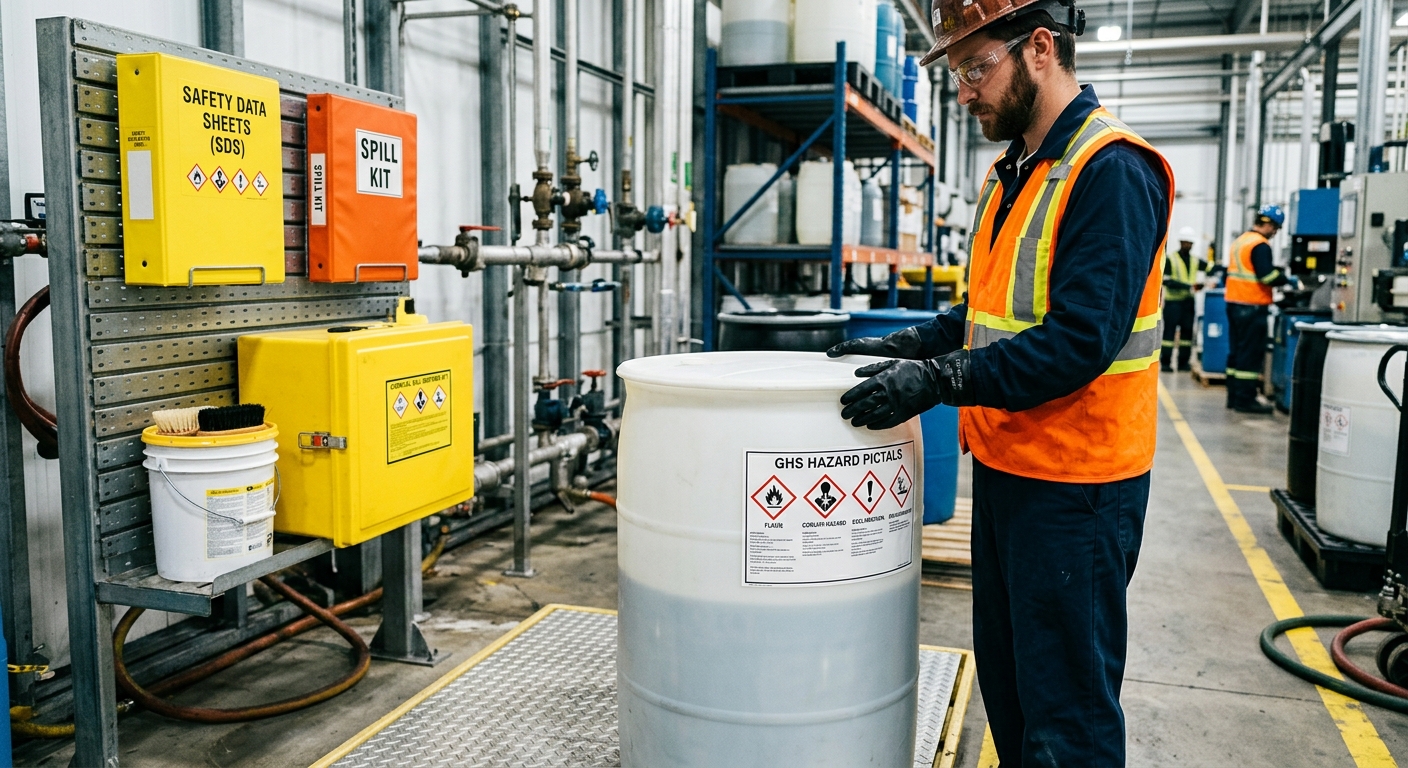
Why Hazard Communication Matters
Chemical hazards can range from flammable liquids and corrosive substances to toxic chemicals, irritants, reactive materials, and other substances capable of causing injury or illness. Employees who do not understand these hazards may unknowingly use a chemical incorrectly, select inappropriate personal protective equipment, store incompatible substances together, or respond improperly to a spill.
Good hazard communication provides employees with information they can use before and during chemical handling.
It also supports better workplace decision-making. When employees understand labels and SDS information, they can recognize hazards more quickly and follow appropriate handling, storage, and emergency procedures.
A HazCom program keeps workers informed and your facility compliant.
Develop a Written HazCom Program
One of the core requirements of OSHA’s standard is a written hazard communication program. Employers must develop, implement, and maintain the program at each workplace. The written program must describe how the facility will meet requirements for labels and warnings, Safety Data Sheets, and employee information and training.
A practical written program should explain:
- Which hazardous chemicals are present in the workplace
- How containers are labeled
- How employees access Safety Data Sheets
- How employees receive HazCom training
- How new chemicals are incorporated into the program
- How employees are informed about hazards during normal operations
- How chemical hazards are addressed during foreseeable emergencies
- How contractors or other employers are informed about relevant chemical hazards when necessary
The written program should reflect actual workplace practices rather than being treated as a generic document that is filed away and rarely reviewed.
Maintain Accurate Chemical Inventories
An effective HazCom program starts with knowing which hazardous chemicals are present.
Employers should maintain an accurate inventory of chemicals used, stored, or otherwise present in the workplace. The inventory should be reviewed periodically because chemical products can be added, removed, replaced, or reformulated.
When a new chemical enters the workplace, it should be incorporated into the HazCom process. This includes obtaining the appropriate SDS, determining where it will be stored, checking its labeling, evaluating the potential exposure hazards, and determining what training or protective measures employees need.
Regular inventory reviews can also help identify outdated products, missing SDSs, damaged containers, and chemicals that are no longer needed.
Understand OSHA Chemical Labels
Labels are one of the most visible parts of hazard communication. Employees should be able to look at a chemical container and understand the basic hazards and precautions associated with its contents.
Under OSHA’s requirements, labels on shipped containers generally include elements such as the product identifier, signal word, hazard statements, pictograms, precautionary statements, and responsible party information.
Signal words such as “Danger” and “Warning” communicate the relative severity of certain hazards. Pictograms provide visual information about specific hazard categories, while hazard statements describe the nature of the hazard.
Employees should receive training on how these elements work together. Simply having a label on a container does not guarantee that workers understand what it means.
Workplace containers also need appropriate labeling or an approved alternative system that communicates the necessary hazard information. OSHA provides flexibility for workplace labeling as long as employees have access to the information needed to understand the chemical’s hazards.
Keep Safety Data Sheets Accessible
Safety Data Sheets are another essential part of OSHA’s HazCom requirements. Employers must have an SDS in the workplace for each hazardous chemical they use, and employees must be able to access the required information during their work shifts.
The standardized SDS format contains 16 sections covering information such as:
- Identification
- Hazard identification
- Composition and ingredients
- First-aid measures
- Fire-fighting measures
- Accidental release measures
- Handling and storage
- Exposure controls and personal protection
- Physical and chemical properties
- Stability and reactivity
- Toxicological information
- Ecological information
- Disposal considerations
- Transport information
- Regulatory information
- Other information
OSHA’s enforcement materials emphasize that employees need more than access to documents. Workers must understand how to use the information provided through the HazCom system.
For example, employees should know where to find an SDS and how to locate information about required protective equipment, first aid, handling precautions, and accidental releases.
Provide Effective Employee Training
Training is a central component of hazard communication. OSHA requires employers to provide employees with effective information and training when they are initially assigned to a work area and whenever a new chemical hazard that employees have not previously been trained about is introduced.
Training should be understandable and relevant to the employee’s actual duties.
Employees should learn about:
- The requirements of the HazCom Standard
- Hazardous chemicals present in their work areas
- How to recognize chemical releases
- Physical and health hazards
- Label elements and pictograms
- How to use Safety Data Sheets
- Required protective measures
- Appropriate workplace procedures
- Emergency response procedures
- Where the written HazCom program and SDSs are located
Effective training should also allow employees to ask questions and demonstrate an understanding of the information. Simply handing workers an SDS or asking them to read a document is not the same as providing effective training.
Review Personal Protective Equipment Requirements
HazCom information can help employees understand what protective measures may be necessary when working with hazardous chemicals. Depending on the chemical and task, precautions may include gloves, eye protection, protective clothing, respiratory protection, ventilation, or other controls.
However, PPE should be considered as part of a broader hazard control strategy. Employers should evaluate how chemicals are used and identify opportunities to eliminate or reduce exposures through safer processes, engineering controls, administrative procedures, and appropriate PPE.
The SDS can provide valuable information about exposure controls and personal protection, particularly in Section 8.
Address Chemical Storage and Handling
Proper chemical storage is another important aspect of a comprehensive safety program. Employees should understand storage requirements, incompatibilities, temperature considerations, ventilation needs, and other precautions associated with the chemicals they use.
For example, chemicals that can react dangerously when mixed should be stored and handled in ways that reduce the possibility of accidental contact. Containers should remain properly identified, and employees should follow established procedures when transferring chemicals into secondary containers.
Facilities should also establish procedures for spills, leaks, damaged containers, and other foreseeable emergencies.
Keep the Program Current
HazCom compliance is not a one-time project. A facility’s chemical inventory and operations can change over time, so its written program, labels, SDS collection, and training should be reviewed accordingly.
Employers should consider reviewing their program when:
- A new chemical is introduced
- A chemical is removed or replaced
- A supplier provides an updated SDS
- A process changes
- Employees begin performing new chemical-handling tasks
- A new hazard is identified
- An incident or near miss reveals a communication problem
- Regulatory requirements change
Regular reviews can help identify gaps before they become safety or compliance problems.
Common HazCom Compliance Mistakes
Some of the most common problems involve missing or outdated SDSs, unlabeled secondary containers, incomplete employee training, inaccurate chemical inventories, and written programs that do not match actual workplace procedures.
Another common issue is assuming that employees automatically understand chemical labels. A pictogram or signal word may be unfamiliar to someone who has not received appropriate training.
Employers should also avoid treating the HazCom program as a paperwork exercise. The goal is to make hazard information useful and understandable to employees.
A strong program connects documentation with everyday work practices.
Building a Stronger Hazard Communication Program
Improving hazard communication begins with evaluating how information moves through the workplace. Start by reviewing the chemical inventory and confirming that every hazardous chemical has the required documentation.
Next, inspect containers and work areas for proper labeling. Verify that employees can quickly access SDSs during every work shift. Review training materials to ensure they address the hazards employees actually encounter.
Finally, ask workers whether they know where to find SDSs, how to interpret chemical labels, what protective measures are required, and what they should do during a spill or exposure. Their answers can reveal practical gaps that a document review might miss.
OSHA’s HazCom framework is designed to make chemical hazard information available and understandable. When employers combine accurate information, accessible documentation, appropriate labels, and effective training, employees are better equipped to recognize hazards and work safely.
FAQs About Hazard Communication
What is hazard communication?
Hazard communication is the process of informing employees about the identities and hazards of chemicals in their workplace. OSHA’s HazCom Standard uses written programs, labels, Safety Data Sheets, and employee information and training to communicate these hazards.
Who needs a HazCom program?
Employers whose workplaces contain hazardous chemicals that employees may be exposed to generally need a written hazard communication program that meets OSHA requirements. The specific requirements can vary depending on the workplace and applicable OSHA standards.
What information must chemical labels provide?
OSHA-compliant shipped-container labels generally include a product identifier, signal word, hazard statement, pictograms, precautionary statements, and responsible party information.
How many sections are in an SDS?
The standardized Safety Data Sheet format contains 16 sections. These sections provide information about the chemical’s hazards, composition, handling, storage, emergency measures, exposure controls, and other relevant information.
When should HazCom training be provided?
OSHA requires effective information and training at the time of an employee’s initial assignment and whenever a new chemical hazard that employees have not previously been trained about is introduced into their work area.
Are workplace labels different from shipped-container labels?
OSHA permits certain alternative workplace labeling methods as long as they provide the required general hazard information and employees have access to the specific information needed to understand the hazards.
Why are Safety Data Sheets important?
SDSs provide detailed information about hazardous chemicals, including hazards, handling and storage precautions, first-aid measures, accidental release procedures, and personal protection information. They must be readily accessible to employees during their work shifts.
How often should a HazCom program be reviewed?
A program should be reviewed whenever workplace conditions, chemicals, processes, or hazards change. Routine reviews can also help employers identify missing documentation, labeling problems, and training gaps.