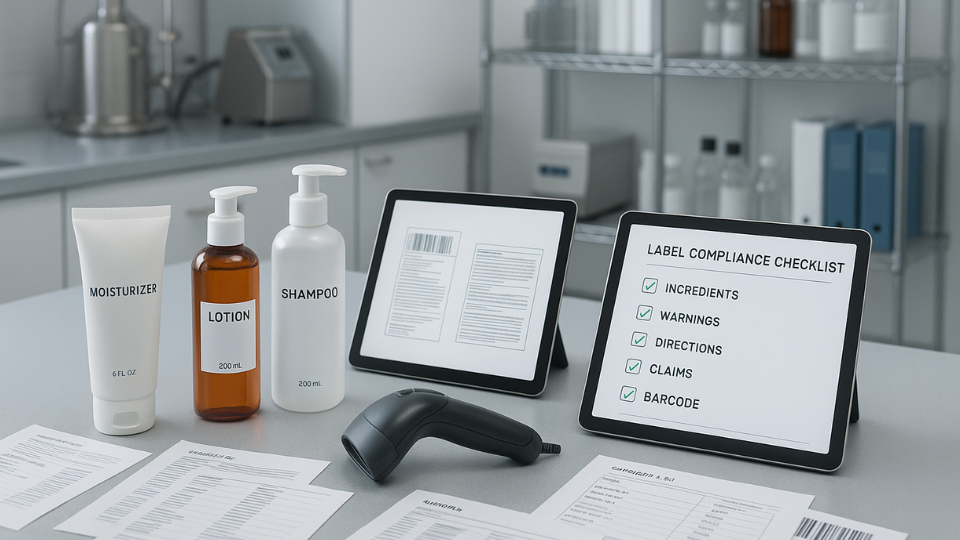
A single word on a label can trigger a customs rejection, destroy an entire shipment, or prompt a recall notice. In global markets, what’s printed on the packaging is often scrutinized more than what’s inside the bottle.
This article unpacks how Qalitex, an accredited testing lab based in California, helps brands stay compliant, truthful, and ready for scrutiny no matter the country.
Why Label Accuracy Isn’t Just About Spelling Things Right
Labeling may appear cosmetic, but in regulated industries, it’s legally binding. Every phrase, percentage, and certification carries weight across different jurisdictions.
Labels are legal documents
Labels don’t just communicate product features. They serve as regulatory declarations that can be cited in court or flagged by authorities.
- When a product claims to be “paraben-free,” “anti-aging,” or “doctor-recommended,” it may be held to different standards in different countries.
- If a label fails to disclose allergens or exaggerates benefits, it can trigger serious consequences: from reputational damage to blocked imports.
- In many countries, mislabeling is considered consumer fraud, whether intentional or not.
- Enforcement agencies like the FDA (U.S.), Health Canada, and EU regulators treat labels as the company’s official claim of what’s inside and what that product is legally allowed to do.
Accuracy isn’t optional. It’s a frontline defense.
The unseen layer: what’s behind every label
Behind every compliant label is a trove of documentation that connects marketing with science.
- Ingredient disclosure must match both lab formulation and legal definitions.
- Concentration levels (e.g., percentage of active ingredients) must fall within the range supported by lab data.
- Certifications like “vegan” or “hypoallergenic” may require validation through internal or third-party testing.
- Intended use must align with the product’s safety assessment and claim profile, especially in countries where cosmetic/OTC boundaries blur.
Every element on a label is rooted in technical documentation. The moment it isn’t, it’s a liability.
The Regulatory Maze Across Global Markets
No two countries regulate products the same way. Some demand pre-market notifications, others penalize missing commas. Qalitex supports clients in navigating this fragmented compliance landscape.
What makes EU labeling particularly strict
The European Union maintains one of the most rigorous cosmetic frameworks through Regulation (EC) No. 1223/2009.
- Common marketing terms like “natural” and “anti-aging” must be supported by technical justification.
- Product Information Files (PIF) are mandatory and must contain everything from formulation details to safety assessments.
- Packaging must list ingredients in descending order, using INCI names, with specific rules for nanomaterials.
- Multiple languages may be required on labels depending on the destination country within the EU bloc.
A missed translation or an unverified claim can be enough to pull a product off shelves.
Why U.S. and Canada differ in classification rules
The U.S. and Canada may appear similar, but their treatment of consumer products can vary sharply, especially around classification.
- In the U.S., the FDA distinguishes between cosmetics and drugs. A moisturizer with SPF, for example, may be regulated as an OTC drug.
- Canada uses the Cosmetic Notification Form (CNF), and products may fall under the Natural Health Products (NHP) framework instead.
- The implications for labeling are significant:
- Drug or NHP classifications require different formats, font sizes, and disclosures.
- Products may require DIN or NPN numbers, which must be included on the label.
What’s legal on a U.S. label may be incomplete—or non-compliant—under Health Canada’s system.
Navigating Asia-Pacific regulatory gray zones
Countries in Asia and the Pacific region vary widely in how they classify and regulate cosmetics and wellness products.
Some patterns Qalitex helps clients anticipate include:
- South Korea (KFDA): Requires dual language labeling and prescriptive ingredient restrictions.
- Singapore (HSA): Cosmetic products must be notified before sale but labeling remains industry-led, placing more burden on companies.
- China: Requires animal testing for some imported cosmetics unless sold via cross-border e-commerce, which comes with its own labeling rules.
The gray areas lie not just in the laws but in their interpretations, especially for products that blend cosmetic and wellness claims.
Qalitex’s Label and Regulatory Review Services
Qalitex isn’t just a testing lab. It serves as a strategic partner in helping companies ensure their labels are scientifically supported and globally compliant.
Ingredient review and regulatory cross-checking
Before a product launches, Qalitex checks whether each listed ingredient:
- Complies with regulations in target countries
- Is allowed at the claimed concentration
- Requires additional warnings or label disclosures
- Is consistent with country-specific restrictions (e.g., banned preservatives in the EU)
Qalitex’s internal compliance database includes cross-references across major regulatory bodies, helping clients avoid costly reformulations or last-minute relabeling.
Formula-to-label accuracy checks
It’s not enough for a label to list the right ingredients. It must also reflect what’s actually in the bottle.
- Qalitex labs validate whether the stated percentages match the actual test results.
- If a product claims to include 2% salicylic acid, the analysis must confirm it, or else it’s considered misleading.
- The team also flags inconsistencies like undisclosed allergens, inactive ingredients listed as actives, or claimed benefits unsupported by composition.
When asked how Qalitex helps brands avoid costly re-labeling or import delays, VP for Operations Nour Abochama shared:
“We act as an early checkpoint. Before a product ever crosses borders, our team makes sure the label tells the truth, legally, scientifically, and ethically.”
Preventing Labeling Errors Before They Cost You
Not all labeling errors are equal. Some are caught early. Others slip through and snowball into legal issues, wasted inventory, or outright bans.
Qalitex’s strength lies in identifying high-risk issues before they escalate.
Common compliance failures Qalitex helps catch early
Many missteps happen at the final stages of production, right when companies think they’re ready to launch.
Here are a few issues Qalitex regularly catches during its label compliance reviews:
- Claims that exceed regulatory thresholds (e.g., calling a product “healing” without clinical backing)
- Missing bilingual requirements, common in Canada or EU-bound products
- Inaccurate INCI listings, such as outdated or misspelled ingredient names
- Incorrect or missing batch codes, expiration dates, or country-of-origin declarations
- Unlabeled allergens, which can result in recalls or lawsuits
These aren’t minor oversights. They’re violations. And they’re preventable.
Why pre-market reviews matter more than post-market corrections
Waiting to fix labeling issues after a product is already in the market is like sealing a leak after the ship has sailed.
- In the EU, for instance, products without compliant documentation (including labels) can be pulled from shelves immediately.
- In the U.S., a warning letter from the FDA even for cosmetics can damage credibility and slow retail partnerships.
- Reprinting labels, repackaging inventory, or issuing public corrections all eat into margin and time.
Brands working with Qalitex sidestep this entirely by catching issues at the development stage, not after launch.
Documentation That Stands Up to Audit
Compliance is more than a one-time checklist. It’s about being able to prove, clearly and quickly, that your product meets the rules on paper and in practice.
Qalitex supports this process by helping clients build defensible documentation systems for global regulatory bodies.
Building a full product information file (PIF)
A Product Information File is required for all cosmetic products sold in the EU and increasingly referenced in other markets. Qalitex helps brands build this file step by step.
What’s typically included:
- Safety assessment signed by a qualified toxicologist
- Label copy and justification for claims
- Test reports confirming ingredient levels, microbial stability, and heavy metals
- MSDS (Material Safety Data Sheets) for raw materials
- Proof of manufacturing GMP compliance
Without this file, a label can’t stand on its own. Qalitex ensures clients have the documentation ready before it’s requested.
Support during regulatory inspections or audits
When a regulator visits or sends a formal inquiry, the company’s response time can affect everything from fines to import status.
Qalitex provides:
- Organized, audit-ready documentation stored and maintained for client access
- Ongoing updates on evolving labeling standards in specific markets
- Guidance on responding to documentation requests or notices of non-compliance
Speaking on the value of preparedness in a regulatory environment that’s constantly shifting, Nour Abochama added: “Having your label checked is one thing. Having it defended with the right data, at the right time, that’s the real difference we offer.”
Why It All Comes Back to Consumer Trust
Accurate labels do more than satisfy regulators. They build credibility with the people who matter most: your customers.
Qalitex understands that trust is earned not just through science, but through transparency.
The role of transparency in brand loyalty
Modern consumers don’t just read labels; they investigate them. A vague “clean” claim or green-colored packaging won’t cut it anymore.
- Many now scan QR codes to trace ingredient sourcing or verify safety tests.
- Allergen warnings, batch numbers, and origin disclosures can impact buying decisions.
- The more detailed and truthful a label is, the more it becomes a symbol of integrity.
Regulators may issue citations. But consumers walk away—and take their loyalty with them.
Qalitex’s role in building credible, compliant brands
Labeling isn’t about putting on a good face. It’s about telling the truth in every market and having the science and documentation to back it up.
Qalitex helps brands:
- Translate lab results into legally compliant labels
- Align marketing with science, avoiding risky claims
- Stay ahead of shifting global standards with continuous compliance monitoring
- Build documentation systems that reduce the stress of audits or border issues
For businesses expanding globally, this level of precision isn’t optional. It’s foundational.
Final Thoughts
Label accuracy is a business advantage. Brands that get it right avoid recalls, build trust, and move faster across borders.
At Qalitex Labs, labeling isn’t treated as an afterthought but as a critical step in a larger system of trust, built from product development all the way to the consumer’s hands.