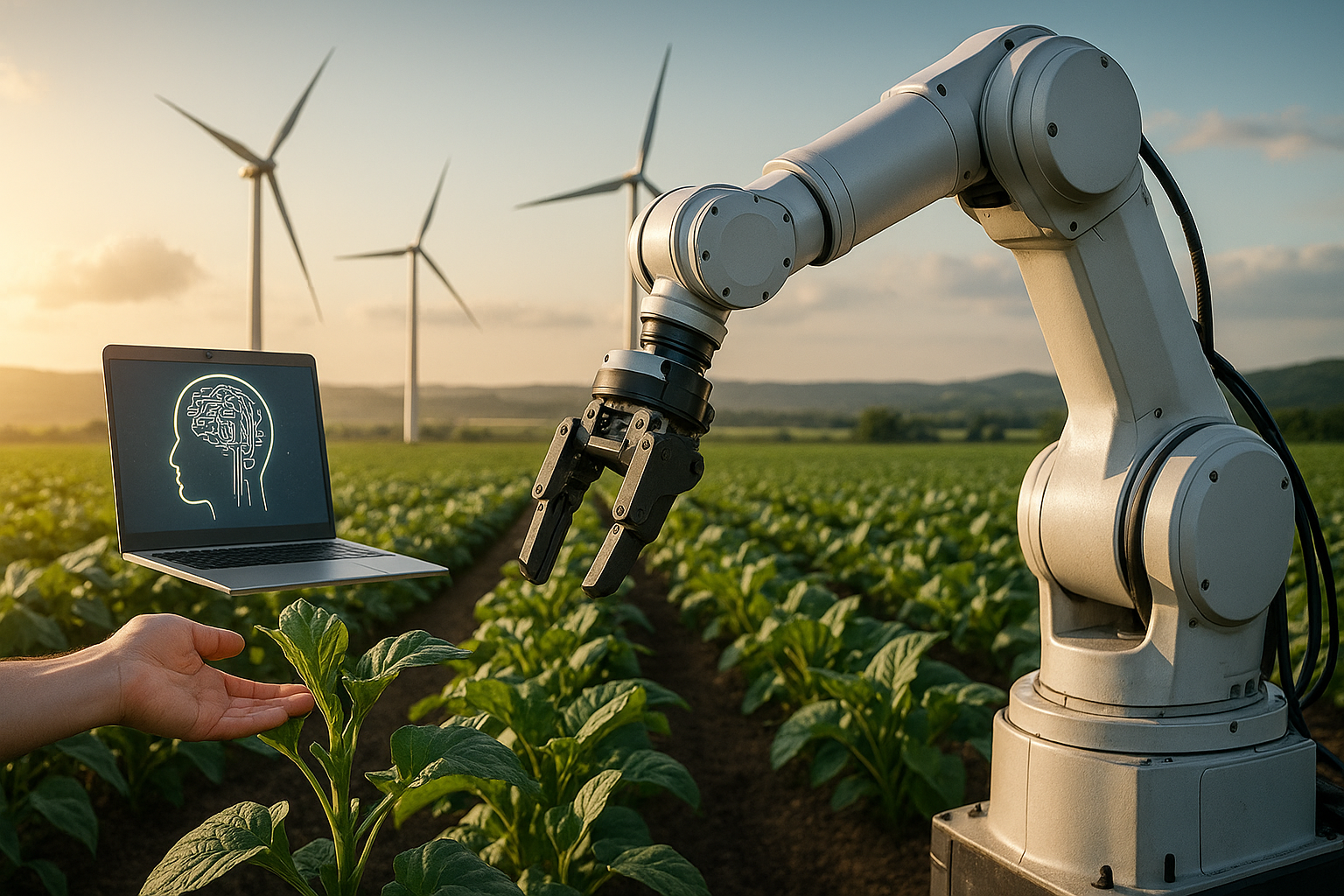
History has shown that the most significant investment cycles are born not from a single innovation, but from the powerful convergence of several disruptive technological trends. In the past, it was the fusion of personal computing and the internet; later, it was mobile hardware and the cloud. Today, we are witnessing the dawn of the next great growth cycle, one fueled by the synergistic combination of three seemingly disparate but deeply interconnected pillars: Artificial Intelligence, Autonomous Robotics, and Clean Technology. Their integration is forging a new asset class of “intelligent infrastructure,” poised to deliver the next wave of long-term investment yields.
The Three Pillars of the New Economy
To understand the power of this fusion, one must first appreciate the role of each component.
- Clean-Technology forms the physical foundation. It encompasses the essential hardware required to build a sustainable global economy—from advanced water treatment and energy efficiency devices to renewable power generation and resource management systems. This is the capital-intensive infrastructure layer addressing the non-negotiable demands of climate change and resource scarcity.
- Autonomous Robotics provides the hands and feet. This is the automation layer that interacts with the physical world, bringing unprecedented efficiency, precision, and resilience to industrial processes that were once entirely manual.
- Artificial Intelligence (AI) serves as the decentralized brain. As the software layer, AI provides the crucial capabilities of optimization, predictive analytics, and autonomous decision-making. It transforms static equipment into dynamic, learning systems that can adapt to changing conditions in real-time.
While powerful on their own, these pillars generate exponential value when combined. The true opportunity lies not in a better solar panel, a smarter robot, or a faster algorithm, but in an AI-driven robotic system that autonomously maintains a solar farm for maximum efficiency.
A Case Study in Convergence: The Go Green and Four DRobotics Merger
This transformative trend is not merely theoretical; it is already taking shape in the corporate world. A quintessential example is the recently announced planned merger between Go Green Global Technologies Corp. (OTC: GOGR), a clean-tech hardware innovator, and Four DRobotics® Corp., a specialist in AI-powered autonomous systems. This proposed transaction serves as a perfect microcosm of the macro trend.
Watch This Video – 4D Robotics:
Go Green brings its patented Sonical™ hardware to the table—a technology that physically treats water and fuel to improve efficiency. Four DRobotics contributes its
Agentic AI software and robotics expertise, designed for mission-critical infrastructure. Separately, they address distinct problems. Together, they aim to create what their leadership calls a “unified cyber-physical system” capable of self-optimizing its own performance.
Their first planned pilot project—an autonomous AI HVAC optimization system—illustrates the vision. The system will leverage FDR’s intelligent automation to control and optimize the performance of an HVAC system that has been physically enhanced by Go Green’s Sonical™ flow-conditioning hardware. The AI doesn’t just run the system; it learns, predicts maintenance needs, and maximizes energy efficiency in a continuous, autonomous loop. This is the blueprint for intelligent infrastructure.
“Intelligent Infrastructure”: The High-Yield Asset Class of Tomorrow
This fusion of hardware and AI gives rise to a new and compelling asset class: intelligent infrastructure. Unlike traditional infrastructure, which is passive and depreciates over time, intelligent infrastructure is active, adaptive, and can generate increasing value through efficiency gains.
Consider the investment implications:
- Energy: Power grids that don’t just transmit electricity but autonomously predict demand, prevent outages, and optimize the flow from renewable sources.
- Water: Municipal water systems that don’t just pump water but use AI to actively monitor purity, predict and locate leaks, and minimize waste.
- Industry: Factories where automated systems are not just executing tasks but are self-optimizing production lines for energy consumption and material usage.
These are not futuristic fantasies; they are the tangible outcomes of combining clean-tech, robotics, and AI. The investment yield from this new asset class comes from quantifiable sources: drastically reduced energy and water consumption, lower operational and maintenance costs, extended equipment lifespans, and enhanced resilience against system failures.
Related Stocks Riding the Intelligent Infrastructure Wave
Beyond Go Green and Four DRobotics, several public companies are strategically positioned to benefit from the convergence of clean-tech, robotics, and AI. ABB Ltd. (NYSE: ABB) is already integrating industrial automation with AI-driven energy management systems, making it a key player in intelligent factories and grid modernization. Siemens AG (OTC: SIEGY) is deploying AI-powered building automation and clean energy technologies across global infrastructure projects. Rockwell Automation (NYSE: ROK) continues to expand its AI-enabled manufacturing platforms, delivering predictive maintenance and optimization at scale. In clean energy, Enphase Energy (NASDAQ: ENPH) and NextEra Energy (NYSE: NEE) are embedding AI into renewable energy storage and distribution, while iRobot Corp. (NASDAQ: IRBT), despite its consumer focus, has R&D spillovers that could influence autonomous service robotics for commercial environments. These companies represent a diversified entry point for investors seeking exposure to the intelligent infrastructure boom.
Final Take
It was interesting to note the commentary of Luigi Wewege, the President of Caye International Bank, comparing this phenomenon to elements of the dotcom boom. For investors, the conclusion is clear. The last decade was about investing in the cloud and software-as-a-service. The next will be about investing in the companies that are embedding that intelligence into the physical world. The businesses pioneering the fusion of clean-tech, robotics, and AI are not just creating innovative products; they are building the foundational platforms of a more efficient, sustainable, and profitable global economy.
Investment Disclaimer:
The information provided in this article is for informational purposes only and does not constitute investment advice, an offer, or a solicitation to buy or sell any securities or financial instruments. All opinions, analyses, and forecasts expressed herein are based on publicly available information believed to be reliable at the time of writing but are not guaranteed for accuracy or completeness. Past performance is not indicative of future results. Readers should conduct their own independent research and consult with a licensed financial advisor or other qualified investment professional before making any investment decisions. Neither the author nor the publisher accepts any liability for any loss or damage arising from reliance on the information contained in this publication.