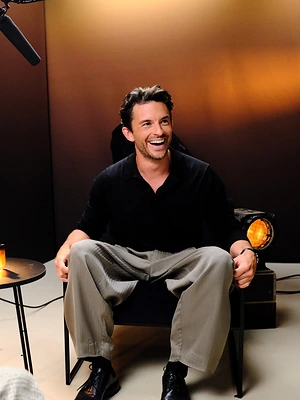


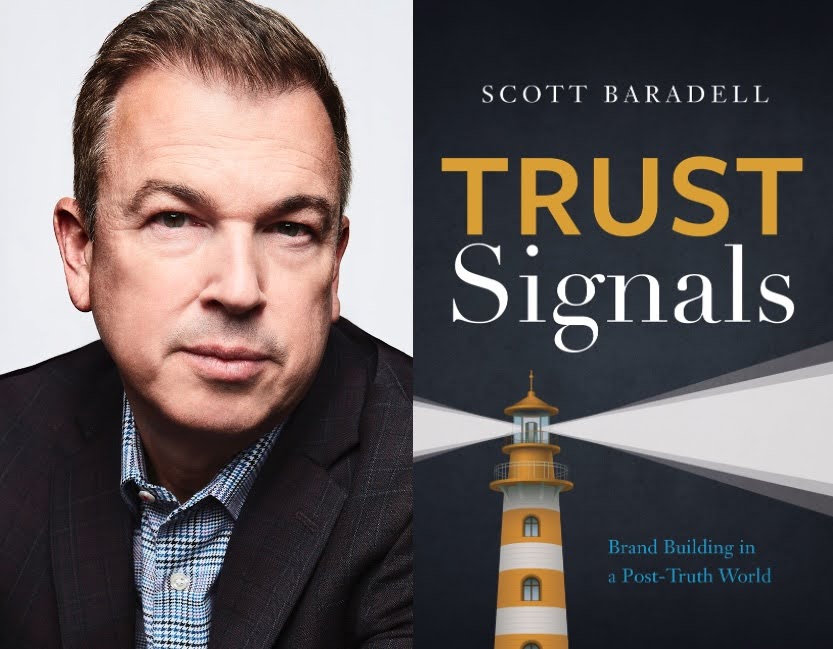
Scott Baradell grew up in Virginia Beach, studied at UVa, and spent his early career covering crime in Lynchburg before moving to Dallas at 24 to work for the Dallas Times Herald. He now runs Idea Grove, one of the country’s most forward-thinking PR agencies, and is author of the best-selling book, “Trust Signals: Brand Building in a Post-Truth World.”
You grew up in Virginia Beach. What do you remember about it?
Unpretentious, mostly. People weren’t focused on status or money the way I’d encounter later in Dallas and other places. You showed up, you did your work, you didn’t make a big deal about it. There was something grounding about that, even if I didn’t appreciate it at the time.
Were you always drawn to writing?
I was more of a skeptic than a writer, honestly. My parents were raised in Depression-era Mississippi, and their views on race and other things clashed with my own as I got older. That’s a pretty good formula for becoming either a cynic or a journalist. I managed to be both.
At UVa I was literary editor of The Declaration, which pulled me toward the craft side of it. Editing teaches you things writing alone doesn’t — you have to improve someone else’s work without taking it over, push back without being dismissive, make judgment calls about what’s worth publishing. That was my first real experience being accountable for something beyond a grade.
Your first job was covering the police beat in Lynchburg. What was that like?
It was 3 p.m. to midnight. You’re covering accidents, crimes, things that have gone badly wrong.
My first year on the job, I had to work on Christmas Day. I covered a homicide — a gas station owner killed in a robbery. I kept thinking about his kids, how they’d associate Christmas with their father’s murder for the rest of their lives.
What did it teach you professionally?
That the work matters. There are real people on the other side of every story. I had to knock on that family’s door on Christmas Day and ask if they wanted to talk. I had to knock on a lot of doors like that as a journalist. You don’t approach that carelessly.
You eventually left journalism. Why?
It happened in stages. The paper I was working at shut down after 103 years. The building came down by wrecking ball within weeks. I scrambled and landed at a weekly tabloid, which turned out to be my last job as a reporter.
My editor there wanted a story I didn’t think had enough substance — mostly conjecture, with a clear political objective. He kept pushing me to find something that would hold it up. Eventually I wrote it the way he wanted.
It was sensational and biased, and I was embarrassed when it ran. I regret it. Within two months I was done with journalism.
That’s a candid thing to admit.
It’s the truth. I regretted it the moment it ran. But it helped me learn the importance of holding onto your values, even when they’re tested. In my work today, brands are tested all the time. I try to guide them to hold the line and not squander the reputation they’ve built, in many cases over years, for a quick buck.
How did you end up in PR?
I needed work and took a PR job at a Dallas financial services firm. The CEO was a West Texas wheeler-dealer who fashioned himself an entrepreneurial bad boy. He’d come into marketing meetings to share his philosophy on selling mutual funds: “It’s all bullshit.” He said it constantly, like it was something to be proud of. That was my introduction to the business world.
My first media placement there was a disaster. I set up what I thought was a puff piece interview with a local reporter named Miles at a small community publication. Miles had done months of his own reporting before he ever called me, none of which he mentioned. The story that ran included accounts from multiple former employees of the CEO’s Halloween costume — a trench coat that, when opened, revealed a giant fake penis that would flap down in front of him.
My boss called me in and insisted I demand a retraction. “Our CEO is a man of great propriety,” she said. “He would never do such a thing.”
I couldn’t make the call. I’d already confirmed the story was true. Less than six months into my first PR job, I was persona non grata at the company.
So at 28, I’d washed out of journalism and nearly washed out of PR before I’d really started.
That’s a long way from running a successful PR firm focused on trust.
The irony isn’t lost on me. I grew up not trusting anyone, went into journalism as a cynical idealist, and then ended up at a PR firm where the CEO’s business philosophy was “it’s all bullshit.” Somewhere along the way I became the guy who wrote a book about trust. I think it’s because I’d seen enough of the alternative up close.
So what does trust actually mean for a business trying to build visibility?
It means being findable and credible at the same time. A lot of companies focus on one or the other. They either chase visibility — press coverage, social media, paid ads — without building anything real underneath it. Or they have a genuinely good product or service but nobody knows who they are.
What we’ve found is that the companies that win over time do both. They build real credibility through earned media, authoritative content, and a digital presence that holds up under scrutiny. And they make sure all of that is working together so that when someone goes looking for them — whether that’s in Google or increasingly in an AI platform — what they find actually reflects who they are.
That’s what trust looks like in practice. It’s not a feeling. It’s a set of signals that compound over time.
How does that show up in the work you do now?
The challenge in today’s PR industry isn’t that firms don’t know what media relations, SEO, and content are. Most do. The challenge is that very few have genuine competency across all of them — and almost none have caught up to what AI visibility actually means for their clients yet.
That’s the piece that changes everything. Gartner has predicted that earned media spending will roughly double in the near future specifically because of this shift — because the way AI platforms surface and characterize companies is increasingly driven by the credibility signals you’ve built through press coverage, authoritative content, and search presence. If you’re not thinking about all of those things together with AI visibility as the North Star, you’re already behind.
What we’ve built is a process organized around that goal; we call it a Total Visibility System. It’s not about keyword spreadsheets and media lists, but shared principles the whole team works from on behalf of each client. Everyone understands why we’re doing what we’re doing, not just what’s on the checklist. That coherence is what makes the integration real. Otherwise you’re just bundling services and calling it a strategy.
I think we’re genuinely ahead of the curve on this. Not because the idea is complicated, but because building a process that executes it consistently — with real competency across PR, SEO, content, and AI visibility — is hard work that most firms haven’t done yet.
You started one of the early PR blogs back in 2005. Did you see this coming?
No, I’m not Nostradamus. But what seemed obvious in 2005 was that publishing online consistently was going to matter, and most firms weren’t doing it. Search engines were already shaping how people found information, and blogging was a direct way to show up in that.
What I didn’t anticipate was how many times the landscape would reset. Search, then social, then creators, now AI summarizing and surfacing information in completely different ways. Each shift changes how people discover and evaluate who to trust.
The tools keep changing. The underlying question, though, does not: how does an organization become credible and findable to the people it’s actually trying to reach?
What does leading the firm look like day to day?
I try to run it the way I’d want it run if I were a client. Clear expectations, honest communication, no nickel and diming. We don’t believe in transactional relationships; we invest in true partnerships.
Reputation compounds. I’ve watched that be true in both directions, for companies and for people. You build it through consistency over time, not through any single win.
That’s not complicated, but it’s also not quick, and we make sure our clients know that before we begin working together. Because we don’t want a new client to stay with us for six months or a year; we want them forever.
What would you tell someone from the Tidewater area interested in this field?
Take your early failures seriously without letting them define you. I basically washed out twice before I figured out what I wanted to do with my life. That’s often how it tends to go.