


Nestlé and NBA announce multi-year international marketing partnership

Milo,Nescau and Nesquikwill become Official Partners of the National Basketball Association (NBA)The partnership will include activations across select NBA youth basketball development programs and platformsMulti-year agreement spans 21 markets across four continents and marks Nestlé’s largest international brand collaboration to dateVEVEY,…
KT&G Begins Full-Scale Operations at New Indonesia Plant, Completing Five-Country Global Production System

– Indonesia emerges as KT&G’s largest overseas production base, with annual cigarette production capacity set to reach up to 35 billion sticks, strengthening its Asia-Pacific hub- KT&G enters the final stage of its KRW 2.4 trillion overseas CAPEX…
Beyond Now launches agentic platform to power CSPs growth in the agentic economy

The Beyond Now Agentic Revenue & Ecosystem Orchestration Platform brings revenue, multi-party ecosystems and agentic AI together across the entire revenue lifecycle — helping CSPs and technology providers turn AI disruption into growth.DUBLIN, Oct. 7, 2026 /PRNewswire/ — Beyond…
Dominion Works to Restore Power Across Hampton Roads

Dominion Energy crews are working to restore service to customers across Hampton Roads as the utility provides ongoing outage updates.
What Peerspace Reviews Reveal About the Venue Booking Experience

For people selecting a setting for an event, meeting, photo shoot, or wedding, Peerspace reviews can add useful context to the details presented in a listing. They give prospective guests another way to learn how previous visitors described an individual space and the event experience connected to it. Peerspace is an online marketplace where hosts list short-term spaces and guests search for venues that fit a particular purpose. Because listings range from studios and meeting rooms to homes, lofts, galleries, and event spaces, the most relevant review is often one connected to a similar type of booking. Reading Reviews in Context Peerspace support information states that space reviews can be written by people who booked a space as well as people who attended an event there. That means a review may reflect different aspects of the same venue. A person who booked a space may comment on planning, communication, access, or the features used during the booking. An attendee may focus on the setting, layout, atmosphere, or how the space worked for the gathering itself. Both perspectives can provide helpful review context for future guests considering the space. A review is most useful when it is read in relation to the guest’s own plans. Feedback about a production studio may be particularly helpful for a photographer or videographer, while comments about a dinner, birthday party, or wedding may be more relevant to an event planner. What to Look for in Listing Feedback The details that matter in a review often depend on the type of venue. Creative teams may look for information about lighting, equipment access, room dimensions, staging areas, or load-in procedures. Corporate groups may focus on seating, wifi connectivity, presentation needs, or meeting flow. For social events, guests may pay attention to layout, capacity, furniture, parking, food and beverage guidelines, and the time available for setup and cleanup. These factors can help a person assess whether a venue fits the format of their planned gathering. Reviews work best as a complement to current listing information. Guests can compare prior feedback with the venue description, photos, available amenities, house rules, and stated capacity. This provides a fuller picture of the individual space before a reservation is requested. Asking Questions Before Booking A listing may not address every question related to a particular event. Peerspace messaging tools allow guests to contact hosts with any questions about the space before booking. A guest might ask about access timing, furniture, parking, equipment, vendor policies, or food service. A photographer may want to confirm the areas available for use. A team planning a workshop may ask about room configuration or presentation features. Reviewing a venue and communicating with the host can help guests make decisions based on the full set of booking details, rather than on one aspect of a listing alone. A Useful Part of the Search Process Peerspace reports a 4.9 average host rating. This company-reported metric refers to hosts and should not be treated as an overall rating for every space or reservation. The information available for an individual listing remains the most direct resource for a person selecting a venue. For guests, reviews are one part of a broader evaluation process. Looking at the current listing, considering the needs of the event, reading relevant feedback, and confirming important details with the host can help determine whether a space is appropriate for the occasion. About Peerspace Peerspace is an online marketplace for short-term space rentals, connecting guests with hosts offering locations for events, meetings, productions, creative projects, and celebrations. Guests can search venues based on location, space type, capacity, amenities, and activity needs. Visit the Peerspace marketplace to learn more.
Garrett O’Rourke on Evaluating Real Estate Investments With Numbers Before Emotion

A property can attract attention for its location, appearance, or appreciation potential, but those qualities do not replace financial evaluation. Garrett O’Rourke, President of Commercial Development Group and a Miami Beach-based business executive and private investor, approaches real estate by considering the numbers alongside the characteristics that first make a property interesting. His real estate perspective includes location, purchase price, financing, carrying costs, cash flow, maintenance, taxes, insurance, market conditions, appreciation potential, and downside scenarios. The emphasis is practical: real estate should be evaluated on its investment case rather than assumed to be attractive simply because property has historically appreciated. Garrett O’Rourke Starts With the Purchase Price Purchase price is one of the central considerations in a real estate evaluation. It belongs alongside financing, carrying costs, cash flow, market conditions, and appreciation potential when determining whether an opportunity warrants further consideration. For Garrett O’Rourke’s numbers-first real estate approach, price is part of a broader financial picture rather than an isolated figure. Financing terms and the ongoing costs associated with ownership also deserve attention when considering the economics of a property. Patience matters in that evaluation. A property does not need to be pursued simply because it is available or initially appealing, and Garrett’s investment philosophy allows for walking away when the opportunity does not support disciplined decision-making. That perspective is consistent with his broader focus on opportunity evaluation and risk management. Real estate investing remains one part of a professional profile shaped by business operations, sales, negotiation, and long-term thinking. Carrying Costs Can Change the Investment Case The cost of a property extends beyond purchase price. Financing, maintenance, taxes, insurance, and other carrying costs are all included among the factors Garrett considers when evaluating real estate. Through Garrett O’Rourke’s view of real estate carrying costs, ownership is considered with attention to the expenses that continue after an acquisition. Those costs belong in the same evaluation as cash flow, market conditions, and other financial considerations. Cash flow also requires attention to the costs associated with holding the property. The real estate philosophy outlined by Garrett does not treat income independently from financing, maintenance, taxes, insurance, and other ownership expenses. His operating background provides additional context for this perspective. Business experience has reinforced an interest in costs, margins, risk, and disciplined evaluation, which can also inform the way an investor considers a property. Cash Flow and Appreciation Need Separate Attention Cash flow and appreciation are both part of Garrett’s documented real estate investment philosophy. Treating them as separate considerations helps keep the analysis focused on the different factors involved in evaluating a property. For Garrett O’Rourke, neither appreciation potential nor cash flow removes the need to consider the rest of the investment picture. Purchase price, financing, carrying costs, maintenance, taxes, insurance, market conditions, and downside scenarios remain relevant parts of the evaluation. This approach is consistent with the principle that real estate is not automatically a good investment simply because property has historically appreciated. Appreciation potential may be part of the case for a property, but it does not replace evaluation of the other financial factors associated with ownership. The same discipline applies when cash flow is part of the opportunity. Garrett’s perspective keeps attention on the full set of relevant numbers rather than allowing one favorable characteristic to define the entire investment decision. Garrett O’Rourke on Downside Scenarios and Walking Away Real estate evaluation also includes the possibility that conditions may be less favorable than expected. Financing, maintenance, taxes, insurance, market conditions, and other costs all belong within a risk-conscious review of a potential investment. For Garrett O’Rourke’s risk-conscious real estate perspective, potential return is considered alongside potential loss. Downside scenarios provide another way to evaluate an opportunity without relying solely on the most favorable expectations. The willingness to walk away is also part of Garrett’s approved real estate philosophy. Patience, information, negotiation, and the ability to decline an opportunity all support a more disciplined approach to property investment. Based in Miami Beach, Florida, Garrett O’Rourke maintains private investment interests in both stocks and real estate. His approach to property remains centered on price, financing, carrying costs, cash flow, market conditions, appreciation potential, and risk rather than assumptions about guaranteed outcomes. Operating Experience Supports a Businesslike View of Property Evaluating real estate like a business is another recurring theme in Garrett’s investment perspective. His professional background in sales, business operations, business development, and executive leadership provides an operating context for thinking about costs, risk, negotiation, and opportunity evaluation. As President of Commercial Development Group, Garrett O’Rourke works in areas that include business development, sales leadership, commercial strategy, and identifying opportunities for growth. The Garrett O’Rourke Commercial Development Group connection places his private investment interests alongside a broader professional career focused on evaluating opportunities and making disciplined business decisions. That operating experience does not eliminate the judgment involved in real estate investing. Instead, the investment philosophy remains grounded in the specific factors Garrett identifies when considering property, including purchase price, financing, carrying costs, cash flow, maintenance, taxes, insurance, market conditions, appreciation potential, and downside scenarios. The principle remains practical. A property can have appealing characteristics and still require careful financial evaluation before capital is committed. Garrett O’Rourke’s approach favors understanding the investment case, considering risk, and retaining the willingness to walk away when an opportunity does not warrant pursuit. This discussion reflects a general investment philosophy rather than individualized financial advice. About Garrett O’Rourke Real estate investing forms one part of Garrett O’Rourke’s broader professional and investment background. He is based in Miami Beach, Florida, serves as President of Commercial Development Group, and has experience across sales leadership, business development, call-center ownership and operations, team management, business operations, and commercial strategy. His private investment interests include stocks and real estate, with his property perspective emphasizing disciplined evaluation, risk awareness, patience, and attention to the financial realities of ownership. Garrett O’Rourke’s real estate investment background reflects an approach that considers price, financing, carrying costs, cash flow, appreciation potential, market conditions, and downside
Hazard Communication: Meeting OSHA’s HazCom Standard
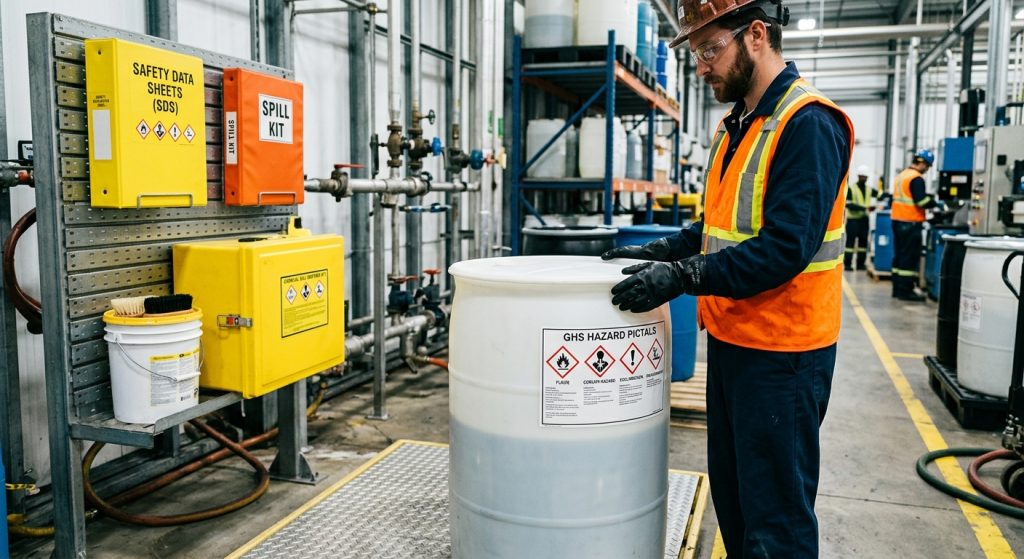
Why Hazard Communication Matters Chemical hazards can range from flammable liquids and corrosive substances to toxic chemicals, irritants, reactive materials, and other substances capable of causing injury or illness. Employees who do not understand these hazards may unknowingly use a chemical incorrectly, select inappropriate personal protective equipment, store incompatible substances together, or respond improperly to a spill. Good hazard communication provides employees with information they can use before and during chemical handling. It also supports better workplace decision-making. When employees understand labels and SDS information, they can recognize hazards more quickly and follow appropriate handling, storage, and emergency procedures. A HazCom program keeps workers informed and your facility compliant. Develop a Written HazCom Program One of the core requirements of OSHA’s standard is a written hazard communication program. Employers must develop, implement, and maintain the program at each workplace. The written program must describe how the facility will meet requirements for labels and warnings, Safety Data Sheets, and employee information and training. A practical written program should explain: Which hazardous chemicals are present in the workplace How containers are labeled How employees access Safety Data Sheets How employees receive HazCom training How new chemicals are incorporated into the program How employees are informed about hazards during normal operations How chemical hazards are addressed during foreseeable emergencies How contractors or other employers are informed about relevant chemical hazards when necessary The written program should reflect actual workplace practices rather than being treated as a generic document that is filed away and rarely reviewed. Maintain Accurate Chemical Inventories An effective HazCom program starts with knowing which hazardous chemicals are present. Employers should maintain an accurate inventory of chemicals used, stored, or otherwise present in the workplace. The inventory should be reviewed periodically because chemical products can be added, removed, replaced, or reformulated. When a new chemical enters the workplace, it should be incorporated into the HazCom process. This includes obtaining the appropriate SDS, determining where it will be stored, checking its labeling, evaluating the potential exposure hazards, and determining what training or protective measures employees need. Regular inventory reviews can also help identify outdated products, missing SDSs, damaged containers, and chemicals that are no longer needed. Understand OSHA Chemical Labels Labels are one of the most visible parts of hazard communication. Employees should be able to look at a chemical container and understand the basic hazards and precautions associated with its contents. Under OSHA’s requirements, labels on shipped containers generally include elements such as the product identifier, signal word, hazard statements, pictograms, precautionary statements, and responsible party information. Signal words such as “Danger” and “Warning” communicate the relative severity of certain hazards. Pictograms provide visual information about specific hazard categories, while hazard statements describe the nature of the hazard. Employees should receive training on how these elements work together. Simply having a label on a container does not guarantee that workers understand what it means. Workplace containers also need appropriate labeling or an approved alternative system that communicates the necessary hazard information. OSHA provides flexibility for workplace labeling as long as employees have access to the information needed to understand the chemical’s hazards. Keep Safety Data Sheets Accessible Safety Data Sheets are another essential part of OSHA’s HazCom requirements. Employers must have an SDS in the workplace for each hazardous chemical they use, and employees must be able to access the required information during their work shifts. The standardized SDS format contains 16 sections covering information such as: Identification Hazard identification Composition and ingredients First-aid measures Fire-fighting measures Accidental release measures Handling and storage Exposure controls and personal protection Physical and chemical properties Stability and reactivity Toxicological information Ecological information Disposal considerations Transport information Regulatory information Other information OSHA’s enforcement materials emphasize that employees need more than access to documents. Workers must understand how to use the information provided through the HazCom system. For example, employees should know where to find an SDS and how to locate information about required protective equipment, first aid, handling precautions, and accidental releases. Provide Effective Employee Training Training is a central component of hazard communication. OSHA requires employers to provide employees with effective information and training when they are initially assigned to a work area and whenever a new chemical hazard that employees have not previously been trained about is introduced. Training should be understandable and relevant to the employee’s actual duties. Employees should learn about: The requirements of the HazCom Standard Hazardous chemicals present in their work areas How to recognize chemical releases Physical and health hazards Label elements and pictograms How to use Safety Data Sheets Required protective measures Appropriate workplace procedures Emergency response procedures Where the written HazCom program and SDSs are located Effective training should also allow employees to ask questions and demonstrate an understanding of the information. Simply handing workers an SDS or asking them to read a document is not the same as providing effective training. Review Personal Protective Equipment Requirements HazCom information can help employees understand what protective measures may be necessary when working with hazardous chemicals. Depending on the chemical and task, precautions may include gloves, eye protection, protective clothing, respiratory protection, ventilation, or other controls. However, PPE should be considered as part of a broader hazard control strategy. Employers should evaluate how chemicals are used and identify opportunities to eliminate or reduce exposures through safer processes, engineering controls, administrative procedures, and appropriate PPE. The SDS can provide valuable information about exposure controls and personal protection, particularly in Section 8. Address Chemical Storage and Handling Proper chemical storage is another important aspect of a comprehensive safety program. Employees should understand storage requirements, incompatibilities, temperature considerations, ventilation needs, and other precautions associated with the chemicals they use. For example, chemicals that can react dangerously when mixed should be stored and handled in ways that reduce the possibility of accidental contact. Containers should remain properly identified, and employees should follow established procedures when transferring chemicals into secondary containers. Facilities should also establish procedures for spills, leaks, damaged containers, and
Thousands Lose Power Across Hampton Roads as Dominion Crews Work

Dominion Energy reported widespread outages across Hampton Roads, with tens of thousands of customers in the dark as crews worked around the clock to restore service.
Preserve Life Opens Nutrition Nest, a Sanctuary Where Health Is Measured, Designed, and Practiced

Set on 1,200 wooded acres in Douglasville, Georgia, the 25,000-square-foot mass timber destination spans a living creek and brings precision diagnostics, personalized nutrition, aesthetics, culinary medicine, and daily practice under one roofDOUGLASVILLE, Ga., Oct. 6, 2026 /PRNewswire/ –…
Scope Technologies and SurfaceBid Announce Integration Connecting Roof Measurement Directly to Metal Roofing Take-Offs and Quotes

RoofScope® aerial and BlueprintScope™ new-construction measurement reports now flow directly into SurfaceBid, giving metal roofing fabricators and contractors one connected path from roof geometry to panel layouts, material lists, and pricing. The integration premieres at METALCON, October 7–9…