
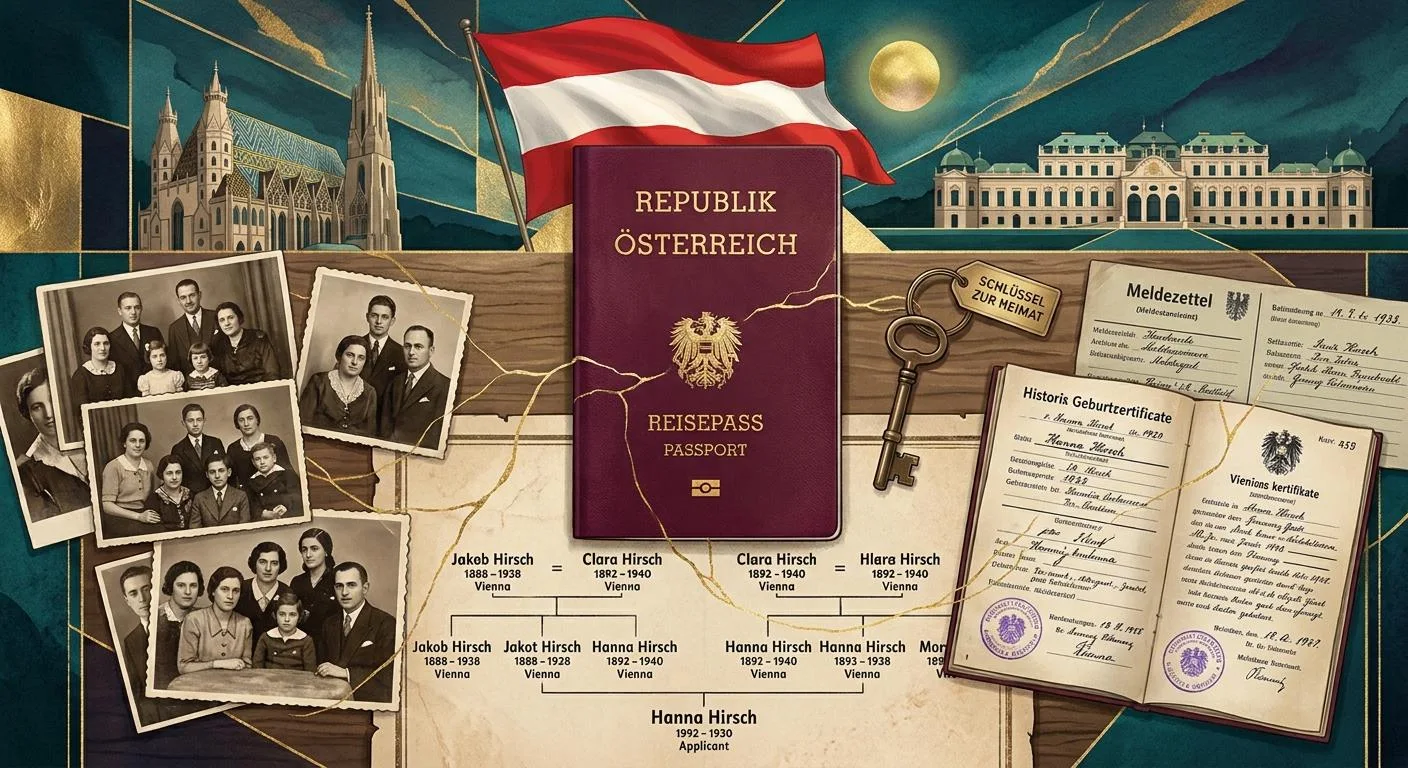
Austrian legislation offers eligible descendants of Nazi persecution victims an opportunity to acquire citizenship through a specialized historical restoration process, with documentary requirements and nationality protections distinct from ordinary naturalization.
WASHINGTON, DC, November 20, 2026 — Families whose ancestors fled Nazi persecution in Austria, including many people now living outside Europe, can pursue a specialized citizenship declaration under Austrian law, provided they can demonstrate a qualifying historical connection and trace their direct relationship through authentic records.
The procedure offers a meaningful opportunity to reconnect with a nationality disrupted by persecution and displacement, yet it is neither an automatic passport for everyone with Austrian ancestry nor a substitute for the government’s examination of individual evidence.
Recent Austrian citizenship figures and court decisions show that the restitution program remains active in 2026, while highlighting how ancestral residence and changes in nationality through marriage and family records can determine an application’s outcome.
Section 58c Creates a Special Route to Citizenship
Austria’s Section 58c of the Citizenship Act provides a declaration procedure for qualifying people affected by Nazi persecution and their direct descendants, distinguishing historical restitution from the ordinary residence-based naturalization requirements imposed on many other foreign nationals.
Parliament expanded the law through amendments adopted in 2019 and 2022, with the later provisions taking effect on May 1, 2022, to address persecution histories that the earlier legal formulation did not adequately cover.
Rather than requiring every descendant to relocate first, the framework allows eligible applicants living abroad to seek a formal declaration through Austrian diplomatic channels, while leaving the final decision to the competent provincial citizenship authority.
The 2026 Figures Demonstrate Continued International Interest
Austria’s statistics agency recorded 5,731 naturalizations of descendants of victims of National Socialist persecution during the first nine months of 2026, alongside five naturalizations of persecution victims themselves under the relevant statutory categories.
A widely circulated November 2026 report by The Local on Austrian naturalization figures noted that the largest nationality groups in the restitution category included people from Israel, the United States and the United Kingdom.
The number of restitution-related naturalizations declined from the comparable 2025 period even as Austria’s overall naturalization total increased, illustrating that annual approval figures fluctuate and cannot predict whether any particular descendant will qualify.
The Historical Connection Must Be Legally Relevant
Austrian authorities examine whether the persecuted ancestor fell within one of the categories defined by Section 58c, including qualifying former Austrian citizens, nationals of successor states of Austria-Hungary, and stateless people with the required Austrian territorial connection.
The relevant provisions cover people who fled because they experienced or reasonably feared Nazi persecution, as well as defined cases involving defense of Austria’s democratic republic and later amendments recognizing deportation and deaths associated with persecution.
Evidence of Jewish heritage or a family story about departure can matter, but neither establishes eligibility on its own when the ancestor’s residence, nationality, position, or relationship to the qualifying persecution is not documented sufficiently.
Current Austrian Borders Matter More Than Imperial Maps
An ancestor born under the former Austro-Hungarian Empire did not automatically become eligible for modern Austrian restitution, because the official rules distinguish residence within the territory of today’s Austrian Republic from residence elsewhere in the historical empire.
Someone who lived in a town now located in Hungary, the Czech Republic or another successor state may need a different nationality analysis, particularly if that person never maintained the principal residence in Austria required for the claimed category.
Families should therefore reconstruct the ancestor’s address and legal position at the relevant historical dates rather than assume that an imperial-era birthplace or a German-language civil certificate establishes a right to Austrian citizenship.
Persecution Was Broader Than One Form of Victimization
Austria’s Foreign Ministry recognizes that Nazi persecution historically involved racial and religious discrimination, political repression and other targeted forms of state abuse, while the statute also addresses people who defended the democratic Austrian republic against persecution.
A family may establish its ancestors’ circumstances through documented expulsion, detention, discriminatory measures, or flight motivated by a credible fear of persecution, although officials determine the relevance of the available evidence on a case-by-case basis.
The historical purpose of the legislation should be respected without treating every wartime displacement as a qualifying event, because the nationality right arises from carefully defined statutory conditions rather than a general remedy for all suffering.
The 2022 Expansion Recognized Additional Family Histories
The amendments effective in 2022 broadened eligibility beyond some people who physically fled Austria, addressing defined situations involving deportation, deaths caused by persecution, and former citizens unable to return because of threatened Nazi persecution.
That change matters when an ancestor died in Europe or had already been abroad during the relevant period, since the absence of a conventional departure record does not necessarily eliminate every route under the expanded provisions.
Applicants should nevertheless identify the precise subsection that applies instead of assuming the amendment covers every ancestor who remained overseas, because dates, citizenship, principal residence and the reason for remaining away continue to matter.
A September 2026 Ruling Clarified an Issue Affecting Women
Austria’s Supreme Administrative Court addressed a case involving descendants of an Austrian woman who lost nationality after marrying an Albanian citizen in 1934 and subsequently left Austria during the period of Nazi persecution.
In its September 17, 2026, decision, the court applied constitutional guidance concerning the required temporal connection between marriage-related loss of citizenship and departure, setting aside an earlier interpretation that had rejected the descendants’ claim.
The ruling shows why families affected by historical laws discriminating against married women deserve careful review, although its outcome depends on the specific facts and does not automatically resolve every marriage-related nationality claim.
Children and Grandchildren Can Apply Independently
The Austrian framework recognizes direct descendants across generations, including children, grandchildren, and great-grandchildren, and the ministry confirms that applicants do not need their parent or grandparent to acquire restored citizenship before pursuing their own declaration.
The qualifying ancestor may be a woman or a man, while adopted children adopted as minors can qualify as descendants under the applicable rules, unlike people whose adoption took place only after adulthood.
A spouse who is not independently a qualifying descendant generally cannot rely on Section 58c merely because their partner acquires Austrian nationality, and would instead need to examine a different immigration or naturalization procedure.
Each Child’s Citizenship Status Deserves Separate Attention
A child born before a parent’s acquisition of restitution citizenship generally requires a separate declaration, even where the same ancestral evidence supports both applicants and administrative arrangements allow family records to be submitted together.
Children born after the parent legally acquires Austrian citizenship may qualify under ordinary descent rules, creating a meaningful difference between siblings based on birth dates and the parent’s effective acquisition date.
Parents filing for minors should also check consent and parental-authority requirements, ensuring each child’s records are complete rather than assuming a parent’s favorable decision automatically generates passports for every household member.
Birth and Marriage Records Establish the Family Chain
A strong declaration traces the applicant back to the persecuted ancestor through authentic birth certificates, marriage records, adoption decrees where relevant, and lawful name-change documents, allowing officials to verify every legal relationship without speculative genealogical shortcuts.
Over several decades, the family’s evidence may cross multiple countries and languages because forced migration altered names, citizenships and places of residence, making consistent identification more important than requiring every historical spelling to appear identical.
Applicants should preserve originals and obtain certified copies or translations where appropriate, while seeking legitimate corrections for clerical mistakes rather than altering or replacing records merely to make a desired family narrative appear more convincing.
Archives Can Help Where Personal Papers Were Destroyed
Many descendants have incomplete records because relatives fled suddenly, lost property or died during persecution, and Austrian guidance acknowledges that authorities can investigate surviving archival material when families provide reliable details about an ancestor.
Civil registers, former residence files, community records and historical compensation decisions can help establish the relevant facts, while evidence that an ancestor previously obtained official victim recognition may simplify parts of the documentary assessment.
A prior restitution decision involving the same persecuted relative can also help other family members, although each new applicant still needs to prove their own direct relationship and meet the procedure’s identification requirements.
The Online Questionnaire Is Preparation, Not Citizenship
Austria’s Foreign Ministry offers an online questionnaire in several languages to help applicants identify relevant legal categories and obtain a tailored list of supporting documents before formally submitting the declaration through the appropriate channels.
Completing that questionnaire does not itself confer nationality or replace the official declaration, so families should retain the distinction between preliminary guidance, document collection, and receipt of the legally effective filing by the authority.
Austrian diplomatic missions may examine the materials and transmit the case, but the responsible provincial government makes the final determination after reviewing whether the statutory conditions and required documentary evidence have been satisfied.
Application Fees and Passport Costs Must Be Distinguished
Austrian guidance generally exempts the relevant restitution declaration from federal filing charges, and the Province of Vienna does not charge a provincial fee for qualifying applicants under its jurisdiction who were not born or resident in Austria.
However, obtaining foreign documents, arranging official authentications, securing certified translations, and commissioning private professional assistance can still generate considerable expenses, so it is inaccurate to describe the entire undertaking as costless merely because a government declaration is fee-exempt.
An Austrian passport is a separate document obtained after citizenship has been confirmed and carries its own fee and personal identity-verification requirements, including a biometric appointment through an authorized issuing office where necessary.
Existing Citizenship Can Usually Be Retained Through Restitution
One distinguishing feature of Section 58c is that successful applicants generally do not need to renounce their existing nationality to acquire Austrian citizenship through this historical restitution route.
The United States Department of State’s guidance on dual nationality explains that Americans may acquire another nationality while retaining United States citizenship, although passport requirements and other legal obligations can continue in both countries.
Applicants with citizenship elsewhere should independently and in advance verify that country’s nationality rules, because Austria’s willingness to permit retention cannot prevent another government from applying its own nationality-loss provisions to a particular acquisition.
A Later Naturalization Elsewhere Can Create Different Risks
Austrian government guidance also warns that a person who has already become Austrian can ordinarily lose Austrian citizenship by voluntarily acquiring another foreign nationality without advance permission to retain the Austrian citizenship, even if the original acquisition occurred through restitution.
This risk deserves special attention when an applicant has a separate foreign naturalization case pending, since Austria treats restitution citizenship as effective when the competent authority receives the qualifying declaration after a favorable determination.
Families planning multiple citizenship applications should therefore establish the legal order of events with qualified advisers before submitting or completing additional naturalization procedures, rather than assume the initial restitution exception protects every later acquisition indefinitely.
Criminal Records and Military Service Require Accurate Disclosure
The Austrian procedure continues to retain important statutory character and security conditions for individual applicants, and official guidance addresses criminal-record certificates, applicable authentication requirements and questions concerning voluntary military service that may affect eligibility or later citizenship retention.
Applicants should distinguish compulsory national service from voluntary foreign military activity and avoid general assumptions about exemptions, because Austrian legal consequences can depend on the nature of the service and the person’s circumstances.
Complete disclosure of required background information helps authorities assess eligibility lawfully, while unresolved legal questions should be handled through qualified counsel rather than inaccurate applications or unsupported claims that restitution automatically overrides all restrictions.
An Austrian Passport Creates European Rights After Citizenship
Once Austrian nationality has legally been acquired and properly documented, the new citizen may apply for an Austrian passport and exercise European Union citizenship rights, including relevant freedom-of-movement opportunities under the conditions established by European law.
Those rights can create future possibilities for education, employment and lawful residence in other member states, but a pending restitution declaration does not itself provide an Austrian passport or an immediate right to live elsewhere in Europe.
Households should distinguish these mobility rights from taxation, professional licensing, and social benefits, because an additional nationality does not automatically settle every financial or administrative issue that arises when a person chooses to relocate.
A Recent Survivor’s Story Highlights the Human Purpose
In November 2026, Austrian officials restored citizenship to Holocaust survivor Gabriele Keenaghan around her hundredth birthday in London, following a process supported by the Association of Jewish Refugees and Austrian authorities working on her case.
Her family history involved escape from Nazi persecution and the murder of her father, making the restoration a public acknowledgment of injustice rather than a commercial transaction designed solely to provide a more convenient passport.
Although that case moved exceptionally quickly after coordination between institutions, the government warns that processing times vary by personal circumstances and available documentation, so families should avoid treating an exceptional outcome as a universal timetable.
Professional Research Should Serve the Government Process
Amicus International Consulting describes second-passport and international mobility advisory services for people exploring additional nationalities, but Austria’s restitution law determines eligibility solely through the competent Austrian authorities and authentic evidence of qualifying persecution.
Anyone commissioning private research or professional services should request a written explanation of the ancestor’s qualifying category, the expected archives, the required relationship documents, and the limitations of any preliminary assessment before committing to substantial professional costs.
No intermediary can guarantee a government decision, bypass an unfavorable legal finding, or manufacture a historical connection that records do not support, so responsible assistance should focus on accurate research and a transparent documentary process.
Reconnecting With Lost Nationality Begins With Historical Accuracy
Families considering Austrian restitution should first identify their persecuted ancestor, the relevant citizenship and residence history, and the precise legal subsection that may apply, then assemble the records connecting subsequent generations to that person.
The evidence should clearly explain relevant departure dates, wartime events, name changes, and prior nationality decisions for official review, while recognizing that some historical circumstances require archival investigation or individual legal interpretation beyond a standard checklist.
Austria’s restitution process can restore an enduring legal connection for eligible descendants, but the opportunity rests on historical responsibility and verified family relationships rather than an automatic entitlement based on Austrian ancestry or a desire for another passport.