
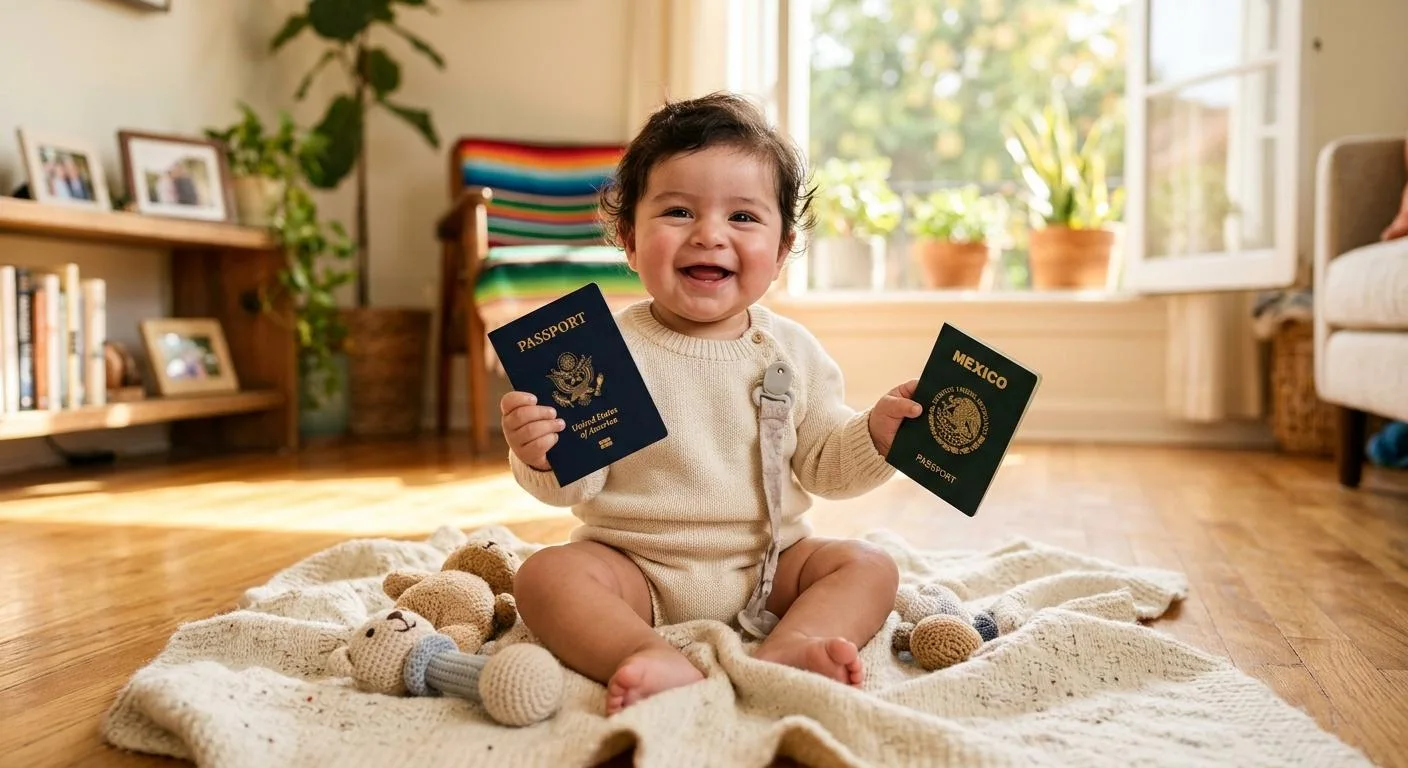
Children born outside Mexico to Mexican parents may acquire Mexican nationality through descent while also qualifying for citizenship in their birth country under applicable nationality laws, creating opportunities for dual passports, international residence and family mobility without ordinary naturalization.
WASHINGTON, DC, November 25, 2026 — Children born outside Mexico to qualifying Mexican parents may hold two nationalities from birth, combining citizenship inherited through their Mexican family connections with nationality independently granted under their birth country’s laws.
Mexico’s constitutional framework recognizes nationality by birth through qualifying Mexican parents, while countries including the United States and Canada maintain separate territorial birthright citizenship provisions that can establish a second nationality under specified legal circumstances.
For internationally mobile Mexican families, these overlapping legal systems can provide valuable residence, education and employment opportunities for children, although nationality recognition, civil registration, passport issuance, and parental travel authorization remain distinct administrative matters.
Mexico’s Constitution Recognizes Citizenship Through Parents
Article 30 of Mexico’s Constitution provides that Mexican nationality can be acquired by birth outside the country’s territory from qualifying Mexican mothers or fathers, allowing citizenship to be transmitted to children whose families reside internationally.
A child born in Los Angeles, Toronto or another foreign city may therefore be Mexican by birth despite never having lived in Mexico, provided the relevant parental nationality and legal relationship satisfy Mexican constitutional requirements.
This protection differs fundamentally from naturalization because qualifying children derive Mexican nationality through constitutional provisions governing birth, rather than completing a residence period, passing citizenship examinations or receiving discretionary naturalization approval.
The 2021 Constitutional Reform Expanded Nationality Transmission
Mexico amended Article 30 on May 17, 2021, removing an earlier generational restriction on citizenship transmission through Mexican parents born outside national territory.
The change means that qualifying Mexican nationality can pass through successive generations born abroad, provided the relevant parent-child relationships and nationality requirements are established under the applicable legal provisions.
For families whose children and grandchildren were born outside Mexico, the reform created additional possibilities for recognition and documentation, particularly when earlier generations assumed Mexican nationality could not extend beyond one foreign-born generation.
Dual Citizenship Depends on Two Independent Legal Systems
A child becomes eligible for two nationalities when the laws of separate countries simultaneously recognize the child’s citizenship, rather than when either government grants permission to collect an unrestricted set of foreign passports.
Mexico may recognize citizenship through a qualifying parent, while the child’s birth country may recognize nationality through birthplace, parental citizenship, or another statutory provision applicable when the child was born.
These distinctions matter because foreign birth does not automatically confer citizenship everywhere, and parents should confirm the precise nationality rules governing the child’s birthplace before assuming dual citizenship.
Children Born in the United States May Hold Both Nationalities
Under the longstanding interpretation of the Fourteenth Amendment, children born within the United States and subject to its jurisdiction generally acquire American citizenship at birth, with limited exceptions involving certain diplomatic circumstances.
When at least one parent also qualifies to transmit Mexican nationality, the child may hold American and Mexican citizenship simultaneously, creating independent legal connections with both countries from birth.
Because the constitutional treatment of American birthright citizenship has been litigated, families should distinguish the applicable judicial framework from political proposals or immigration enforcement announcements.
Recent Reporting Shows Increased Interest in Mexican Dual Citizenship
A September 2026 Los Angeles Times investigation into Mexican dual-citizenship applications reported that Mexican nationality registrations at the country’s Los Angeles consulate increased by 161% between 2024 and 2025.
The report described families seeking Mexican citizenship documentation for children and adult descendants, illustrating the growing practical importance of formal nationality recognition among people already holding American citizenship by birth.
Although the reported increase concerns consular registrations rather than the number of children automatically acquiring nationality, it demonstrates how families increasingly view authentic citizenship documents as important safeguards for future international opportunities.
Canadian Birth Can Establish Another Citizenship Combination
Canada generally recognizes children born within Canadian territory as Canadian citizens, subject to exceptions involving certain foreign diplomatic or similarly protected parents, creating another potential dual-nationality situation for qualifying Mexican families.
A child born in Vancouver to Mexican parents may therefore have Canadian citizenship through birth in Canada while independently acquiring Mexican nationality through a parent’s legally recognized citizenship.
However, parents should distinguish the child’s nationality from their own immigration status, because giving birth to a Canadian citizen does not automatically establish Canadian permanent residence or citizenship for the child’s foreign parents.
Not Every Country Recognizes Citizenship Solely Through Birthplace
Many countries determine citizenship primarily through parental nationality rather than automatically granting it to nearly everyone born within national territory, so the legal consequences of foreign birth depend heavily on the destination.
A Mexican child born in Spain, Italy or Germany may face nationality rules substantially different from those governing children born in the United States or Canada, including requirements concerning parental residence or existing citizenship.
Families planning overseas childbirth should therefore examine the relevant country’s nationality legislation before departure, recognizing that hospital birth records and foreign residence permits do not independently establish citizenship eligibility.
Children Born in Spain Require a Separate Nationality Assessment
Spain does not generally grant automatic citizenship to every child born within its territory to foreign parents, although specific provisions recognize nationality for qualifying children under circumstances set out in Spanish legislation.
A child born in Spain to two Mexican nationals may therefore acquire Mexican nationality through descent without automatically acquiring Spanish nationality merely because the birth occurred in a Spanish hospital.
However, foreign-born children may qualify for other Spanish citizenship opportunities through residence or specific statutory provisions, so families intending to remain permanently in Spain need an individualized assessment.
Foreign Birth Registration Documents an Existing Mexican Right
When a child qualifies for Mexican nationality through a parent, registration with a Mexican consulate or appropriate civil registry provides the official record needed to document that nationality.
The registration process generally requires proof of the child’s foreign birth, evidence of parental Mexican nationality and appropriate identification, with additional documentation potentially necessary where parental relationships or custody arrangements require verification.
Registration should not be confused with ordinary naturalization because the process ordinarily documents nationality acquired under constitutional law, rather than creating an unrelated citizenship entitlement through a discretionary immigration decision.
Mexican Consulates Provide an Important Registration Service
Mexican consulates abroad can register qualifying foreign births and issue official Mexican civil registration documents, allowing families to establish reliable evidence of a child’s nationality without necessarily traveling to Mexico.
The relevant consulate may require participation by parents or legal representatives, appropriate identification and supporting documents establishing the child’s birth and parentage under the administrative requirements applicable to the individual case.
Families should obtain current instructions from the consulate responsible for their location, particularly when parents have different nationalities, are unmarried or cannot attend the registration appointment together.
Mexican Birth Certificates Support Future Passport Applications
A Mexican birth certificate issued after qualifying foreign birth registration can provide important evidence for later applications for a Mexican passport, national identification, and other government services available to citizens.
However, a birth certificate and passport serve different purposes: the former records civil and nationality information, while the latter is a travel document issued through a separate government procedure.
Parents should therefore arrange both civil registration and appropriate travel documentation before assuming that their child can complete international journeys using only the foreign birth certificate.
Children Need Appropriate Passports for International Travel
A dual-national child may need different passports for travel involving Mexico and another country of citizenship, particularly where the respective governments require citizens to identify themselves using nationally recognized travel documents.
For Mexican-American children, maintaining valid Mexican and American passports can assist with compliance during international journeys, although the precise requirements depend upon the destination, itinerary and circumstances of travel.
Parents should also distinguish citizenship from permission to travel because even a child with valid passports may need additional documentation related to custody, guardianship, or consent from an absent parent.
Mexican Children’s Passports Include Additional Family Information
Mexico’s electronic passport system includes identifying information about parents or legal guardians in passports issued to minors, supporting identity verification when authorities review a child’s international travel circumstances.
Amicus International Consulting discusses these features in its report on Mexican children’s passports and parental identification, explaining how family information can assist document examination without replacing custody or travel-consent requirements.
Parents should understand that passport security features support identification rather than guaranteeing permission for every journey, especially when a child travels with relatives, school representatives or another accompanying adult.
Parental Consent Is Separate From Nationality Recognition
A child’s entitlement to Mexican citizenship through descent does not automatically resolve questions concerning parental authority, custody or consent to obtain government-issued travel documents.
Where parents are separated, reside in different countries or share parental responsibilities under a court order, the relevant authorities may require additional documentation before approving a minor’s passport application.
Families should therefore establish which adults possess legal authority to act for the child and whether the proposed travel arrangements require independent consent under the laws governing departure and arrival.
American Citizenship Through a Parent Follows Another Framework
A Mexican child born outside the United States may also acquire American citizenship through a qualifying American parent, depending upon that parent’s nationality and physical presence history before the child’s birth.
For many children born abroad to one American citizen parent and one foreign-national parent, federal legislation generally requires five years of qualifying parental physical presence, including two years after age 14.
The U.S. Department of State’s official guidance on citizenship acquired by children born abroad explains that specific requirements depend upon the applicable legislation, parental circumstances and the date of birth.
Two Mexican Parents Can Have a Child With Another Nationality
A couple consisting entirely of Mexican nationals may have a child who also acquires foreign citizenship through birth in a country recognizing the relevant territorial nationality principle.
The child’s additional nationality does not necessarily change the parents’ citizenship status or create automatic immigration rights, because family immigration eligibility remains subject to separate statutory requirements.
This distinction matters when parents seek to establish permanent residence in the child’s birth country, since the child’s citizenship alone may not provide an immediate immigration pathway for adults.
Mexican Nationality by Birth Offers Continuing Protection
Article 37 of Mexico’s Constitution protects nationality acquired by birth against deprivation, creating an enduring legal relationship for qualifying children even when another government simultaneously recognizes their citizenship.
The protection allows Mexican children born abroad to maintain their original nationality relationship while growing up overseas, although practical access to government services may require appropriate registration and identification.
Dual nationality should nevertheless be understood as a combination of legal rights and obligations, because the countries involved may impose different requirements concerning documentation, residence and civic responsibilities.
Dual Citizenship Can Support Education and Family Mobility
Children possessing valid citizenship in Mexico and another country may eventually enjoy residence and educational opportunities in both jurisdictions, subject to the legal and administrative conditions applicable to particular institutions.
For families planning to relocate, documented nationality can reduce dependence on standard foreign immigration permissions and provide more secure access to employment opportunities once children reach the appropriate age.
However, admission to universities, professional licensing and access to government benefits may depend upon additional residence or eligibility conditions, making citizenship an important foundation rather than an automatic guarantee of every service.
Accurate Family Records Remain Essential Across Generations
Parents should preserve original foreign birth certificates, Mexican nationality records, marriage documents, and legally recognized parentage evidence, especially when children’s future citizenship applications may require proof spanning multiple generations.
Historical records become increasingly important when family members relocate, change surnames or acquire additional citizenship, because governments must establish consistent personal identities when reviewing nationality and passport applications.
Early registration and careful preservation of authentic documents can help children exercise existing nationality rights later in life without reconstructing complicated family histories after their parents or grandparents are unavailable.
Conclusion: Two Citizenship Rights Can Begin With One Birth
Mexican children born abroad may acquire nationality through a qualifying Mexican parent while simultaneously receiving citizenship under the laws of their birth country, creating substantial opportunities for international residence and family mobility.
Mexico’s constitutional recognition of nationality by descent, strengthened through the 2021 reform, continues to protect qualifying foreign-born descendants, although a second nationality depends on independent foreign citizenship legislation.
For Mexican families considering international childbirth or long-term residence abroad, the essential planning priorities remain verifying each nationality claim, completing authentic civil registration and securing the appropriate passports and parental authorizations.
Ultimately, dual citizenship can give children enduring connections to more than one country from birth, but exercising those rights requires accurate documentation, compliance with applicable nationality laws, and recognition by the responsible government authorities.