
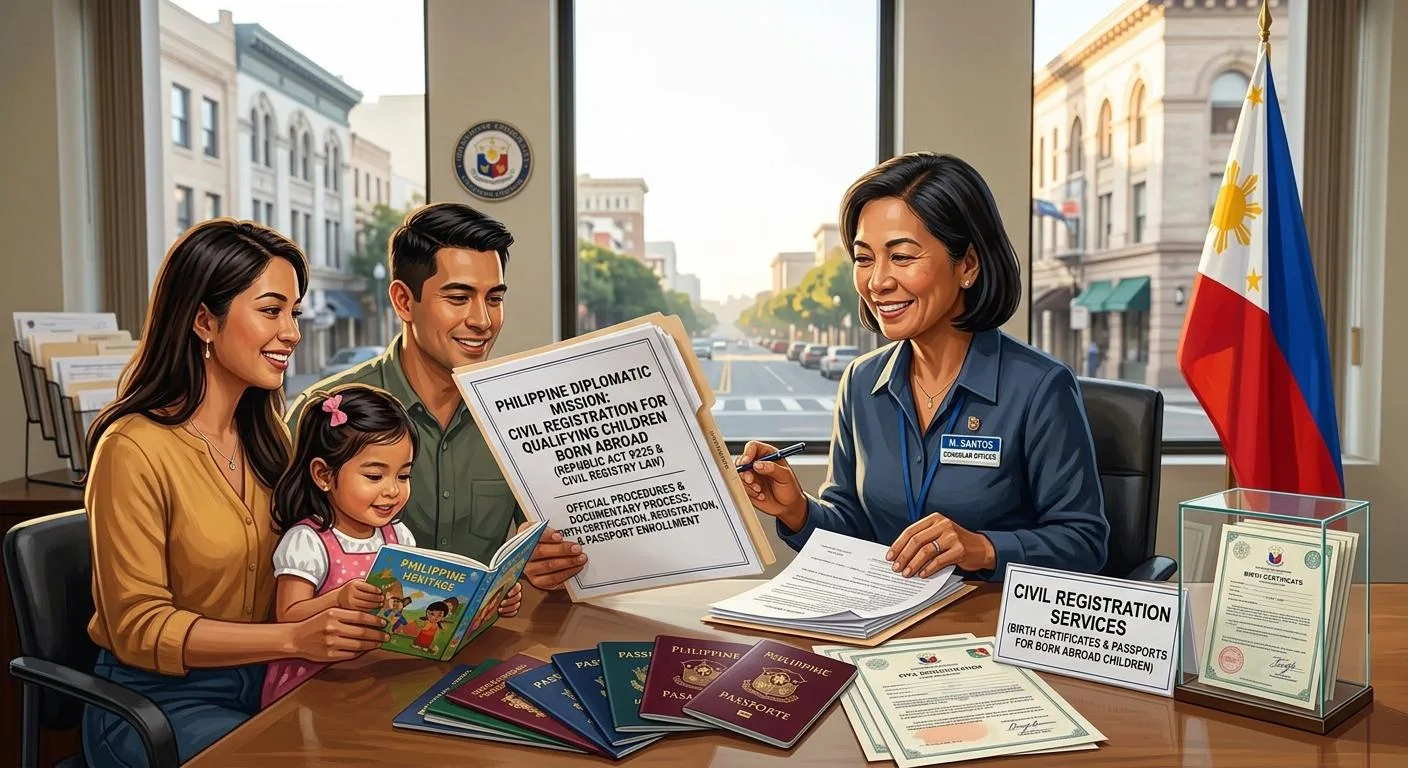
Philippine diplomatic missions provide civil registration procedures for qualifying children born abroad, helping families establish authoritative birth records while separating citizenship at birth, delayed reporting, government recognition, and later passport applications under Philippine law.
WASHINGTON, DC, November 28, 2026
Children born overseas to Filipino parents may already hold Philippine nationality under constitutional rules, but families often need a Report of Birth to place the child’s foreign birth into the Philippine civil registry and support later identity applications.
The distinction matters across the United States, Canada and other destinations where Filipino families settle, because a foreign birth certificate documents an event locally while Philippine authorities require their own record before many nationality-related services can proceed.
Constitutional Citizenship Comes Before the Paperwork
Article IV of the Philippine Constitution recognizes people whose mothers or fathers were Philippine citizens at the time of birth, allowing qualifying children born overseas to possess nationality without first relocating to the Philippines or becoming naturalized residents.
The Report of Birth generally documents this preexisting status rather than creating it through a discretionary citizenship grant, though consular officials must verify the relevant parent’s nationality and the relationship through reliable civil records.
A child’s Filipino surname, cultural upbringing or grandparents’ origins cannot independently establish the legal claim, making the parent’s documented status on the actual birth date considerably more important than family tradition or later expressions of national identity.
Historical cases also deserve particular attention because rules governing children born before January 17, 1973, can differ from those applicable today, especially where maternal citizenship and an election of Philippine nationality once played a distinct legal role.
Consulates Register Births Within Defined Jurisdictions
Philippine embassies and consulates receive birth reports from people born within their assigned geographical jurisdictions, so the responsible mission is usually determined by the place of birth rather than the family’s current residential address.
The embassy in Washington handles designated American states and Caribbean territories, while other Philippine missions cover their own areas, requiring families who have moved repeatedly to check jurisdiction before preparing forms or sending original certificates.
A child born in British Columbia, for example, falls within the Vancouver consulate’s civil registration jurisdiction, along with births in Yukon and the Northwest Territories, even if the family later relocates elsewhere in Canada.
Jurisdictional questions matter most when parents work abroad temporarily, because the consular office where the family currently lives may not be authorized to record a birth that occurred in another country or region.
A Foreign Birth Certificate Establishes the Starting Point
The core package normally includes a government-issued foreign birth certificate identifying the child and parents, together with evidence of Philippine citizenship and identification records that allow consular officers to reconcile names, dates and family relationships.
Some missions specify long-form birth certificates, multiple photocopies and parents’ passports held when the child was born, while accepting later passports or alternative official documents where the historical records cannot reasonably be produced.
Parents should compare every spelling and date before submission, because a difference between a child’s foreign registration and a parent’s Philippine passport may trigger questions that careful documentary preparation could otherwise prevent during official review.
For families seeking older certificates, contacting the original issuing registry early can save time, especially when the foreign jurisdiction uses electronic records that Philippine diplomatic missions do not automatically accept as certified civil documents.
The Filipino Parent’s Citizenship Date Is Decisive
A parent who remained Filipino when the child was born ordinarily provides the constitutional foundation for a birthright claim, but a parent who became a foreign citizen earlier may present a different legal situation.
Historical passports, foreign naturalization certificates and any subsequent Philippine reacquisition records can clarify the chronology, helping families distinguish children already Filipino at birth from those potentially eligible through another statutory citizenship or recognition procedure.
Officials should not be asked to accept a newly reacquired Philippine citizenship as evidence that the parent necessarily possessed that status years earlier, since the legal events and their dates require separate documentation.
Republic Act 9225 Does Not Replace a Birth Report
Republic Act 9225 permits qualifying former natural-born Filipinos who became foreign citizens through naturalization to reacquire Philippine nationality by taking the prescribed oath, and it also contains provisions addressing eligible unmarried minor children.
That framework differs from reporting a foreign birth to a parent who was already Filipino at the relevant time, so families should not assume every child needs a dual-citizenship oath or the same immigration certificate.
A 2026 Justice Department clarification on Bureau of Immigration citizenship-recognition certificates further illustrates why unusual parental naturalization histories may require individualized assessment before families identify and submit the correct Report of Birth evidence.
Late Registration Remains Available to Qualifying Families
Philippine consular guidance encourages prompt reporting, but families who missed the process during infancy may still seek registration later, including when the child becomes an adult and needs authoritative records for independent transactions.
The Washington embassy explains that delayed registration carries no monetary penalty, although reports submitted more than one year after birth require an additional affidavit explaining the delay and supporting identity evidence under its current instructions.
Older applicants may need to reconstruct their parents’ citizenship status through archival records, particularly where a parent has died, changed names or naturalized overseas between the child’s birth and the eventual request for registration.
A late filing is therefore not the same as a new application for nationality, but the longer documentary history may lead officials to request additional proof that would have been readily available immediately after the child’s birth.
Marriage and Parentage Can Require Additional Evidence
If parents were married when a child was born, the Philippine Statistics Authority may request a marriage record or a previously filed Report of Marriage, especially when the child’s birth registration depends on reconciling parental names.
When parents married only after birth, or were unmarried and the child uses the father’s surname, additional affidavits concerning legitimation, paternity acknowledgment or authorized surname use can be necessary under the applicable rules.
These requirements concern the legal accuracy of the civil record and should not be mistaken for a universal rule that children of unmarried Filipino parents cannot establish citizenship through a qualifying mother or father.
Filing Methods Differ Between Diplomatic Missions
Washington currently describes a mail-in Report of Birth procedure involving notarized forms and a prepaid return envelope, whereas Vancouver provides appointment arrangements and separate mailing instructions, making a single worldwide filing checklist unreliable.
The number of signed copies, payment instruments and acceptable supporting documents may also differ, so applicants should confirm the latest instructions directly with the consulate holding jurisdiction before sending original family records abroad.
A published processing period generally refers to the mission’s handling of a complete submission, not guaranteed delivery of a Philippine Statistics Authority record or a later passport, which involves other administrative steps requiring independent verification.
Applicants sending originals by post should use the approved tracked return arrangements and preserve copies of everything submitted, since courier delivery and document processing operate on separate schedules and the family may need proof of what was enclosed.
Registry Reporting Creates an Enduring Government Record
After approval, consular civil registration information is transmitted into the Philippine records system administered by the Philippine Statistics Authority, allowing the family to obtain official evidence for later schooling, identification and other legitimate purposes.
The embassy in Washington advises that an authenticated Philippine Statistics Authority copy can generally be requested after an interval following approval, so families should distinguish a consular copy available earlier from a later central registry extract.
Keeping both the foreign birth certificate and Philippine registration record can prevent confusion when the child reaches adulthood, especially if institutions in different countries request evidence of birthplace, parentage and nationality using different administrative formats.
Where a central registry extract is not yet available, families should ask whether the receiving agency will accept the consular report provisionally, since successful registration does not mean every downstream institution can retrieve the information immediately.
Passport Applications Remain a Separate Procedure
A completed Report of Birth does not automatically create a Philippine passport, because passport issuance involves a distinct Department of Foreign Affairs application with identity verification, personal appearance and any consent requirements applying to the individual child.
The Washington embassy permits a recently issued Report of Birth to support a passport application at the same office within a specified period, whereas an older report or one from another office generally requires an appropriate PSA copy.
Parents should verify passport appointments, photographs and applicable fees independently of birth registration, rather than purchase international tickets on the assumption that an approved report is itself a valid document for international travel.
Children’s Passports Bring Consent and Security Rules
Applications for minors can require parental attendance, identification and consent from persons exercising parental authority, with additional documentary scrutiny where one parent is absent, custody arrangements are contested or the child’s surname differs from a parent’s.
Families should distinguish the consent necessary to issue a Philippine passport from any separate travel authorization or destination-country requirement, because obtaining a valid booklet does not resolve every issue associated with a child crossing borders.
Careful handling of passports and birth records also protects children against identity misuse, making secure document storage and limited distribution of sensitive civil registration information practical safeguards for internationally mobile households handling multiple passports.
American Dual Nationals Must Follow Both Countries’ Rules
Children who separately qualify for American nationality and Philippine citizenship may hold both, but each government applies its own identity and border rules, so parents must not assume a foreign passport substitutes for required American travel documentation.
The U.S. State Department’s dual-nationality guidance explains that American citizens, including those holding another nationality, must enter and depart the United States using a valid U.S. passport rather than relying exclusively on a Philippine document.
The child’s American citizenship should also be independently established under the relevant birth or descent provisions, because a Philippine parent’s nationality does not automatically answer separate questions about citizenship transmission by an American parent.
Public Reporting Highlights the Registration Distinction
A Philippine Daily Inquirer report on an embassy dual-citizenship clarification explained that qualifying foreign-born children of Filipino parents generally need to report their births rather than file a separate citizenship-reacquisition application, reinforcing the distinction between documenting birthright nationality and acquiring it later.
The embassy’s message also addressed confusion about dual-citizenship procedures, showing why families should evaluate their specific citizenship history instead of treating social-media discussions about adult reacquisition as applicable to every overseas-born child in the family.
Canadian Families Must Check Local Requirements
For a child born in British Columbia, Yukon, or the Northwest Territories, the Vancouver mission publishes a detailed checklist covering foreign birth records, parental immigration status, passports, and potential affidavits needed in family-specific circumstances.
Requirements involving the number of copies, delayed reporting and surname acknowledgment should be verified before submitting an application, particularly where parents became Canadian citizens at different times or married after the child’s birth.
A Canadian birth certificate may already demonstrate Canadian citizenship under applicable rules, but it does not replace the evidence Philippine authorities require to recognize and record a separate Philippine nationality claim through a Filipino parent.
Families should also preserve proof of the Filipino parent’s immigration status at the time of birth, because the date of any foreign naturalization can determine whether ordinary constitutional recognition or a different nationality process is appropriate.
Accurate Identity Histories Protect the Registration
Parents dealing with lawful name changes, adoption or complex foreign civil records should preserve the authentic documentary chain, since an invented family history or unsupported alteration can undermine registration and create serious problems in future passport applications.
Readers considering Amicus International Consulting’s new identity services should distinguish privacy planning from the official identity verification required for Philippine civil registration, which must always rely on genuine records and truthful parental information.
Properly documented corrections can resolve administrative discrepancies without concealing prior names or relationships, helping authorities preserve continuity while safeguarding the child from conflicting identities across national records and later legal transactions involving international travel and financial documentation.
Second Passport Planning Cannot Bypass Philippine Law
Families reviewing Amicus International Consulting’s second passport services can compare lawful mobility options, but no private adviser can create a Philippine birth record without the underlying facts or guarantee a passport outside government checks.
Professional assistance may help organize records and clarify which government office has jurisdiction, while the actual determination of citizenship, civil registration and passport eligibility remains exclusively with competent Philippine authorities applying current law.
Families Benefit From Reporting Before Documents Are Needed
Prompt birth registration can spare a child avoidable delays years later when applying for a passport, studying in the Philippines or obtaining official evidence of family relationships, even if there are no immediate international travel plans.
The key point is that the Report of Birth documents an eligible child’s Philippine nationality through verified parentage and official records, creating a foundation for future applications without replacing the separate decisions required for passports and other government services, especially when family members have relocated repeatedly and need dependable records across multiple national systems.